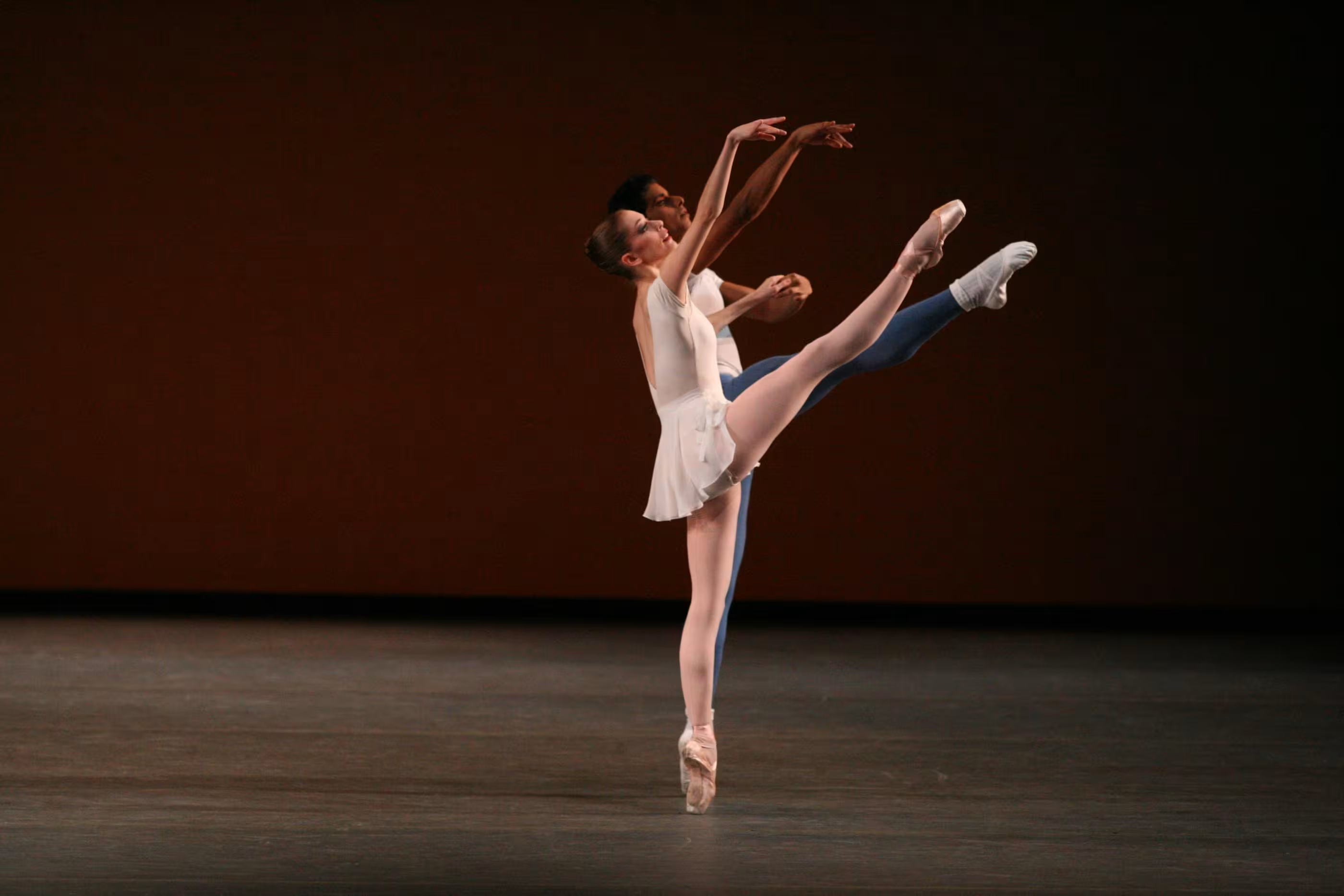


2 & 3 Part Inventions (Phelan, Ramasar, 2017), photo by Costas
A jewel-box neoclassical ballet set to Bach's two- and three-part keyboard inventions, this intimate work for eight dancers demonstrates Robbins' mastery of counterpoint in movement. The dancers' intricate interplay mirrors the fugal logic of Bach's compositions, with each couple or trio weaving their own line through a living polyphonic tapestry.
Special Requirements
Piano on apron
Choreography: Jerome Robbins
Music: Johann Sebastian Bach
Lighting Design: Jennifer Tipton
8 dancers:
4 women
4 men
“The ballet was first made last spring for students of the School of American Ballet. With their youth in mind, Robbins etched a hint playfulness into the twelve J.S. Bach counterpoint studies that he explored….Robbins likes to peruse simple devices like walking, and to find in them a new poetic dimension. When he did this is Glass Pieces, the walking had the directness of blank verse, while in 2 & 3 Part Inventions it has the stately flow of rhymed verse.”
“If any choreographer can make sunlight virtually stream into a theater, it is Jerome Robbins. And that is exactly what he has done again so naturally in 2 & 3 Part Inventions, an infinitely fresh and wonderful new ballet set to Bach’s piano studies….Fortune, aided by the choreographer’s shrewdness, has smiled upon the entire enterprise. At some point, 2 & 3 Part Inventions should certainly be transferred to the City Ballet….For all his concern with form and structure, this is Mr. Robbins at his most relaxed, giving the lie to those who say classical choreography is dead.”
“The new ballet, to the Bach music that seems to be absorbing him of late, is called 2 and 3 Part Inventions, and it is just that, a rediscovery of Bach arranged for a cast of eight, the girls in white leotards and overskirts, and the boys in white T-shirts and blue tights–the white-and-blue of the S.A.B. studios in pre-Lincoln Center days….The new Bach work is, if you like, a continuation of his ballets about dancers…”
“Simplicity is the art of the exquisite but when that sense of the exquisite is imbued with grandeur you know that you are either in the presence of God’s nature or man’s genius….Yet there is nothing much more to Jerome Robbins’ new ballet 2 & 3 Part Inventions that any averagely talented choreographer could not have envisaged….What Robbins possesses–and in choreography it is what distinguishes the good from the great–is the quality of inevitability, of dance and music going together as if they had both thought of one another on the same cool instant.”