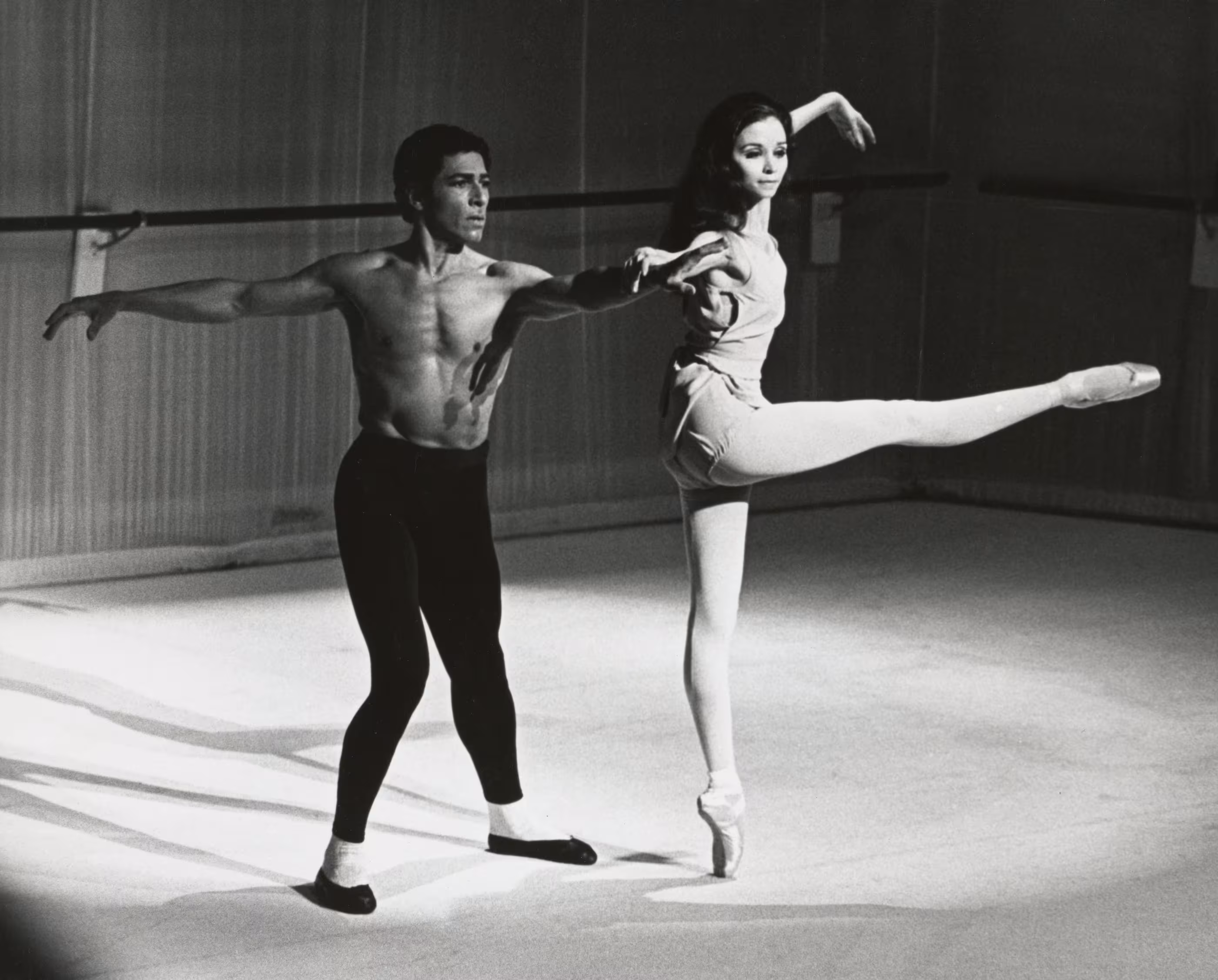

PhotoAfternoon of a Faun (Moncion, Mazzo, 1953) © Martha Swope. Courtesy of the Billy Rose Theatre Division, New York Public Library for the Performing Arts
Transposing Nijinsky's mythological faun to a contemporary dance studio, Robbins' celebrated pas de deux unfolds entirely before an imagined mirror. Two dancers — narcissistically absorbed, faintly erotic — move in a haze of self-awareness. First performed in 1953, created for and dedicated to Tanaquil Le Clercq.
Choreography: Jerome Robbins
Music: Claude Debussy
Costume Design: Irene Sharaff
Lighting Design: Jean Rosenthal
Set Design: Jean Rosenthal
2 dancers:
1 woman
1 man
“It was beautiful and tender, poetic and restrained, and highly imaginative. I wouldn’t be at all astonished if it is remembered as Mr. Robbins’ most artistic gift to ballet….Mr. Robbins has taken the faun out of Greek mythology and put him to work in a dance studio….One masterly stroke was the added illusion that the audience was actually serving as the fourth wall of the dance studio–that is the wall with the mirrors.”
“With the keen insight of a psychiatrist, Robbins has sketched an encounter between boy and girl–each so fascinated in his own mirror image that the one is scarcely aware of the other, even in making love….Tanaquil Le Clercq never looked lovelier. Both she and Francisco Moncion, the boy, catch exactly the gaze and manner of people wrapt up in themselves–of dancers charmed by their bodies….Jean Rosenthal’s curtain set makes an ingenious studio.”
“It is a pas de deux basic in ideas, disarming in its simplicity, and compelling in its mood….The ballet is a study in line and slow-motion, relying heavily on its performers to do it justice….It fell to Tanaquil Le Clercq and Francisco Moncion to have the experience. Their ability to capture and sustain did the trick”
“There is no dancing in it at all in the sense of continuity of phrased movement, and except for three or four beautifully contrived adagio lifts and their resolutions, there is nothing whatever of choreographic texture. Indeed, the piece contains the absolute minimum of movement of any sort to qualify it in the ballet at category, and that only by a wide stretch of the term.”
“Not so many years ago, Nijinsky’s Faun shocked American audiences, for although the participants lived only in myth, they behaved with considerable physical candor. The Robbins Faun is not shocking in the same way at all, but it does invite shock of a different sort, for whether Mr. Robbins intended it or not, his ballet suggests that the dancer is, or tends to be, in love with himself….The idea itself possesses impact and the choreographer has translated it with taste and tenderness, some wry humor and much beauty into the action of dance.”
“Robbins’ new version is imaginative enough and, surely, revolutionary in concept. The ‘rock’ becomes a whisperish cubicle of silk which quivers with every front-row cough and the ‘faun’ becomes a guy with no shirt and rehearsal tights. He awakes to give a gal dancer a few lifts, a few twists and a few strange looks. Then he goes back to sleep again. On a bare floor, yet….Miss Le Clercq was as fragile and liftable as ever. Moncion managed to look fairly dangerous at times. Neither could be arrested for a Mann Act violation.”
“With Afternoon of a Faun, Jerome Robbins discards everything except the sensuousness implicit in the music and presents a ballet which, in effect, is both an exposition and an exploitation of the essential narcissism of the dancer…. Afternoon of a Faun has a hypnotic fascination. Before it is half way through we have the feeling that the dancers we are watching have become the reflection, not the reality. It would be difficult to overpraise the performances of Tanaquil Le Clercq and Francisco Moncion who walk, with superb assurance, the tightrope between reality and fantasy.”
“Using Debussy’s music for the title, Afternoon of a Faun, and developing a pas de deux variation on the themes of both the music and the Mallarme poem which inspired it, Mr. Robbins choreographed one of the most sustained studies in focus and one of the most objective boy-girl relationships in all ballet….For simplicity of means, for directness in the handling of the theme, for brilliance of characterization, and for doing a contemporary work within the framework of the music, Mr. Robbins and the collaborators, Miss Rosenthal and Irene Sharaff who did the simple costumes, are to be highly praised.”
“There is a wonderful sense of theatrical rightness in Mr. Robbins’ choice of the antiseptic studio atmosphere, for his story of nascent love vying with narcissism–not only because dancers live in a world of mirrors, but because this particular format allowed him to concentrate on the mood relationship between the music and his own choreography.”