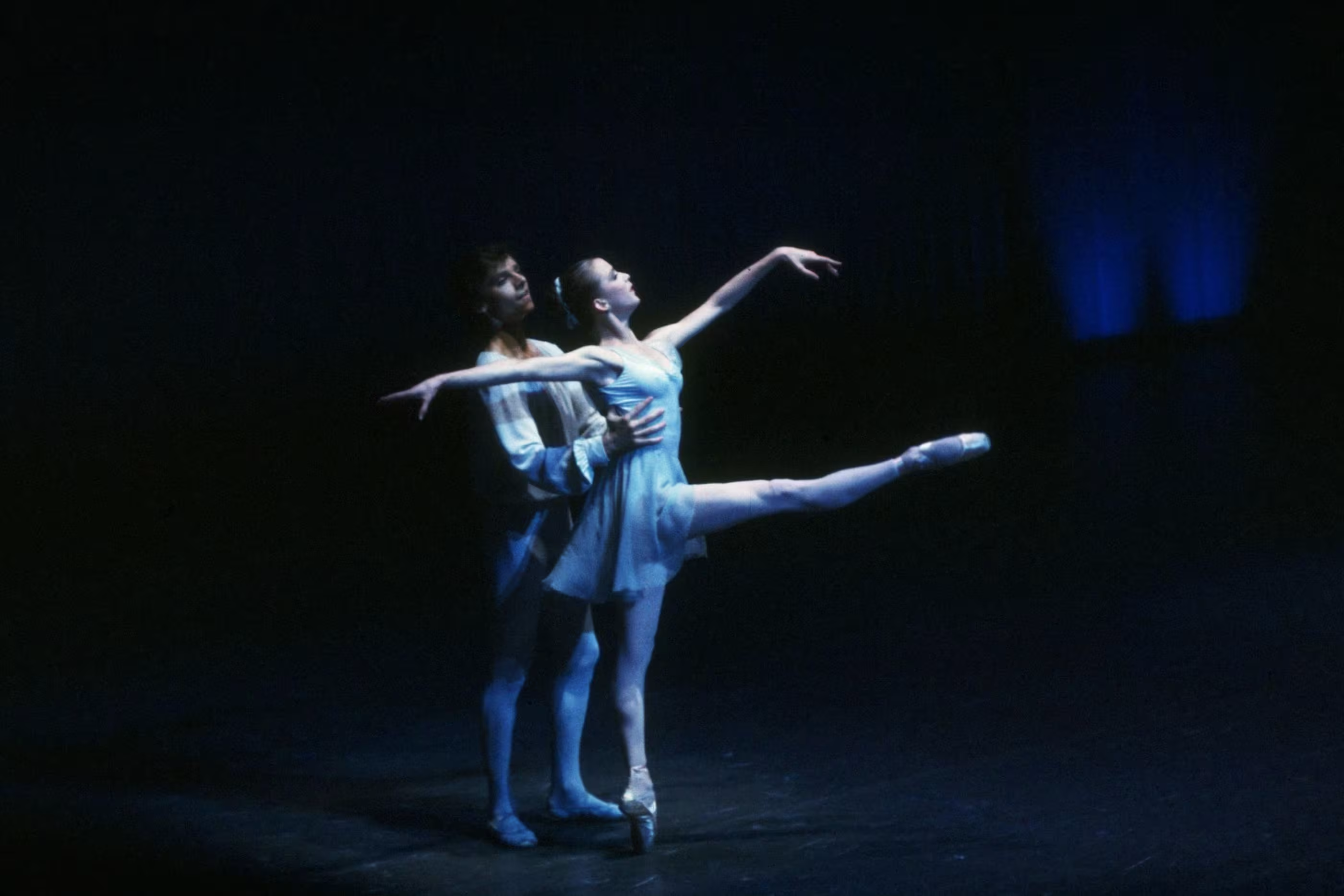

PhotoAndantino (Kistler, Anderson, 1981) © Martha Swope. Courtesy of the Billy Rose Theatre Division, New York Public Library for the Performing Arts.
A refined and intimate pas de deux set to the tenderly song-like slow movement of Tchaikovsky's first piano concerto. Spare, beautifully balanced, and showcasing the pure sculptural rapport between two dancers, this brief duet exemplifies Robbins' ability to find deep feeling within classical constraints.
Choreography: Jerome Robbins
Music: Peter Ilyitch Tchaikovsky
Costume Design: Ben Benson
Lighting Design: Ronald Bates
2 dancers:
1 woman
1 man
“What just might be masterpiece is Jerome Robbins’ classic Pas de Deux to the second movement of Tchaikovsky’s First Piano Concerto….This is Tchaikovsky–and Robbins–the Romantic, and it moves with a heavenly grace….It is also Robbins at his most Balanchinian–there are even sly quotations from Balanchine’s ballet La Sonnambula….It strolled in beauty and wore love with a difference.”
“Mr. Robbins’s Pas de Deux is clear as daylight….Ib Andersen and Darci Kistler give it a fantastic performance. They are stretched to the extreme, in every sense. Miss Kistler grows up in this ballet. She dominates the stage, covering nearly half of it in a leap, and yet in total concord with a partner whom Mr. Robbins pushes beyond his previous capacities. A surprise is Mr. Robbins’s use of skating steps–brilliantly rendered by the dancers.”
“….a short but highly effective Romantic pas de deux that, if it said nothing much, said it with such grace and charm that it captivated the audience completely.”
“Set to the second movement of Tchaikovsky’s First Piano Concerto, it takes you inside the music, translating the composition’s early tentativeness and growing strength in the couple’s shy encounters, and ultimately their sweeping and rapturous lifts.”
“Pas de Deux, to the second movement of the First Piano Concerto, features Darci Kistler and Ib Andersen as a most adventurous and glistening pair of lovers. Although the mood is tender and much of the dancing gliding or drawn out, they seldom repeat anything–oh, a step perhaps, that skater’s spin down to the floor, but not a whole phrase. Tchaikovsky can repeat if he likes, they’ve got too much discovering to do.”
“Robbins’s triumph of personal exposition was Pas de Deux….The very first image in the piece–of colt-like figures drawn to each other from opposite sides of the vast stage, their step gloriously assured, their demeanor honestly reticent–is a metaphor for the whole. It is a romance that’s at once exhilarating and tremulous….The piece is perfect for Kistler and Andersen, and they for it. Its fine workmanship and ingenuity assure it a place in the permanent repertory, yet I can’t imagine anyone else dancing it.”
“Pas de Deux, to a movement from the first piano concerto, suggested a tender meeting for young lovers.”
“Working into a woman’s strengths as he has rarely done before, Robbins shows us the full glory of Kistler’s legs in the Pas de Deux to the Andantino of the First Piano Concerto. He does this via the plié. The whole duet is Kistler moving in and out of plié–some very deep, some delicate, and all in different contexts. The constant bending and unbending of her body is extraordinarily sensual, and the beauty of her motion is such that one almost forgets the thinness of the choreography for Ib Andersen.”
“It perhaps reflects the romantic Balanchine of yesteryear with Robbins’s own veneer of classical poise and a disarming gentleness.”
“Darci Kistler, her dancing growing in ease and elasticity, and Ib Andersen, always a dancer of playful poetry, cover ground in dreamy locomotion through a soft blue atmosphere. They evoke not only the moves and style typical of an ice skating duo–which, naturally, allow for much variety of feeling and tempo–but also its essentially chaste quality.”