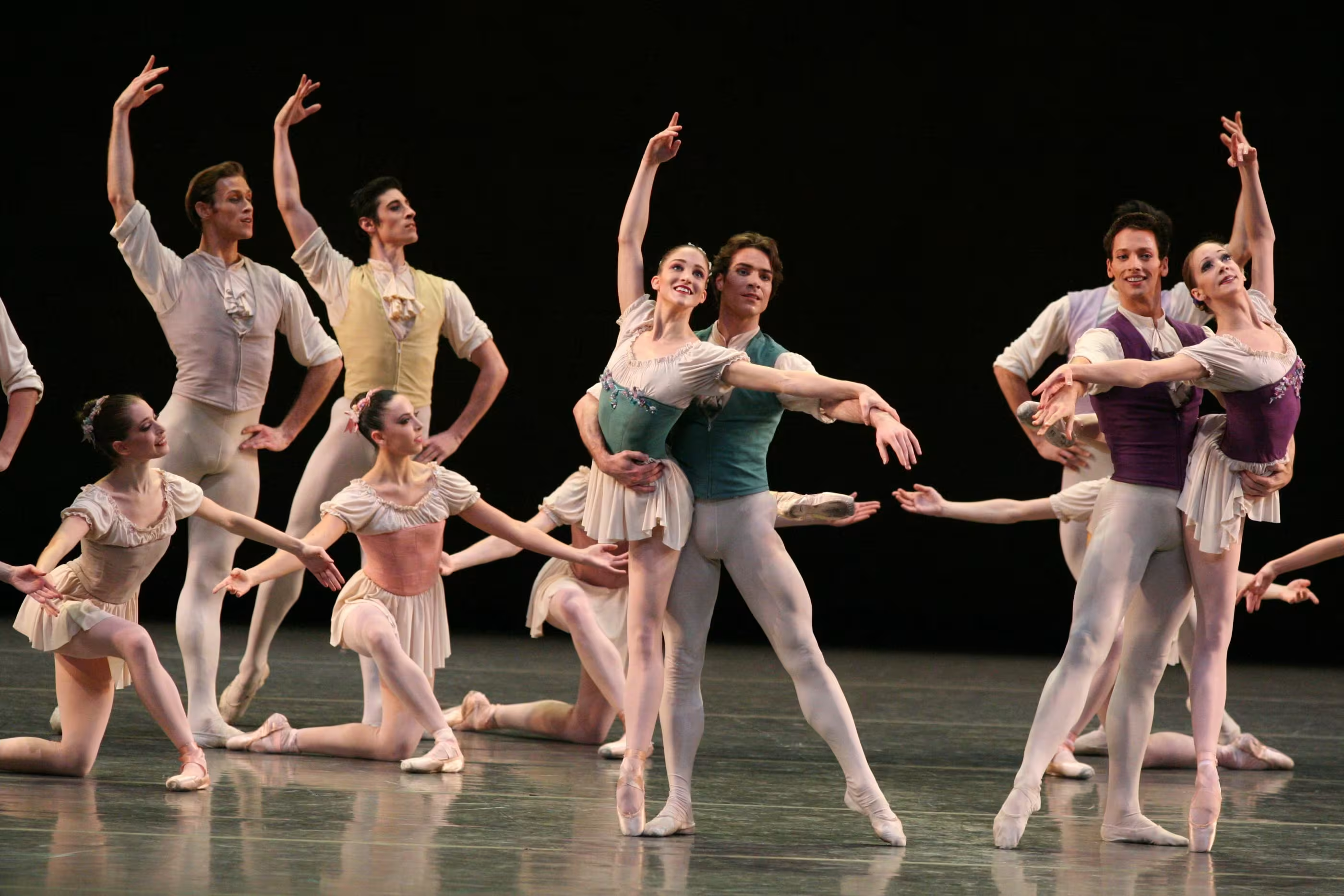


Brandenburg (Bouder, Garcia, 2008), photo by Costas
Robbins' final work, created for New York City Ballet in 1997, returns to the beloved Bach of his youth with a spirit of joyful mastery. Drawing on four of the Brandenburg Concertos, the ballet celebrates pure classical dancing in a blaze of musical vitality and choreographic confidence.
Choreography: Jerome Robbins
Music: Johann Sebastian Bach
Costume Design: Holly Hynes
Lighting Design: Jennifer Tipton
20 dancers:
10 women
10 men
“This is the first piece for his own company since Ives, Songs in 1988, although a couple of years ago the seventy-eight year-old choreographer created a work, 2 & 3 Part Inventions, for the School of American Ballet that was later taken into the main repertory….As with the delightful Inventions, which proved a major success, Robbins for his new piece has turned to the music of J.S. Bach….I suspect Bach would have been delighted in the manner and fashion in which Robbins has caught the music’s style and spirit.”
“Playful and formal, familiar and unpredictable, Brandenburg is filled less with such apparent contradictions than with a rare quality: the capacity to surprise. When the curtain rose on the world premiere of Brandenburg, the wedge of dancers onstage recalled fugitives from many another Robbins ballet to many another composer. Youthful and bouncy, they were the eternal jaunty adolescents that have passed through the Robbins repertory for more than fifty years….Within seconds, Brandenburg takes off on its own into a kaleidoscope of changing patterns….Mr. Robbins has fashioned a do-it-yourself score out of the entire third concerto and excerpts from three others.”
“What struck me most about Brandenburg was its simplicity. Robbins has pared away all the external theatricality of his earlier dances, relying solely on the power of his steps to hold the eye. It is poignant to see a great artist continuing to the end of his career to strive for an ever-truer vision, and as Robbins took his solo curtain call, looking far younger than his years, I was moved to tears. I hope he has a hundred more ballets left in him, but if this should be the last. It will make for a perfect exit.”
“A new ballet by choreographer Jerome Robbins is an event to be cherished….Robbins has created another impressive ballet for the company he has served as a performer, associate artistic director, and ballet master since 1949.”
“…the ballet is a plotless suite of dances in which the performers radiate a sense of well-being and appear happy to be dancing together. There is no attempt to match the 18th-century dance scores with any evocation of 18th-century dance styles (indeed, there are moments when the dancers cut loose and turn cartwheels). Nevertheless, the music’s charms are always echoed in the choreography….Because Robbins’s strongest choreography is to the third and second concertos, which come at the start of the ballet, Brandenburg has a slightly anticlimactic ending. Fortunately, it is not so anticlimactic as to seem dangerously weak.”
“Robbins’ Brandenburg stretches in two directions at once, back through the choreographer’s earlier achievements and forward to the needs of the company’s young artists….For me, the heart of the piece lay in the haunting second pas de deux (Brandenburg No. 2, Andante), in which Lourdes Lopez and Nikolaj Hübbe seemed destined never to touch, and in the first two duets of the succeeding section (Brandenburg Concerto No. 1, Menuetto—Polacca). There, like a master teacher, Robbins transformed choreography into a primer, setting simple, gracious sequences that exposed and challenged the dancers exactly the way Mozart exposes and challenges musicians.”