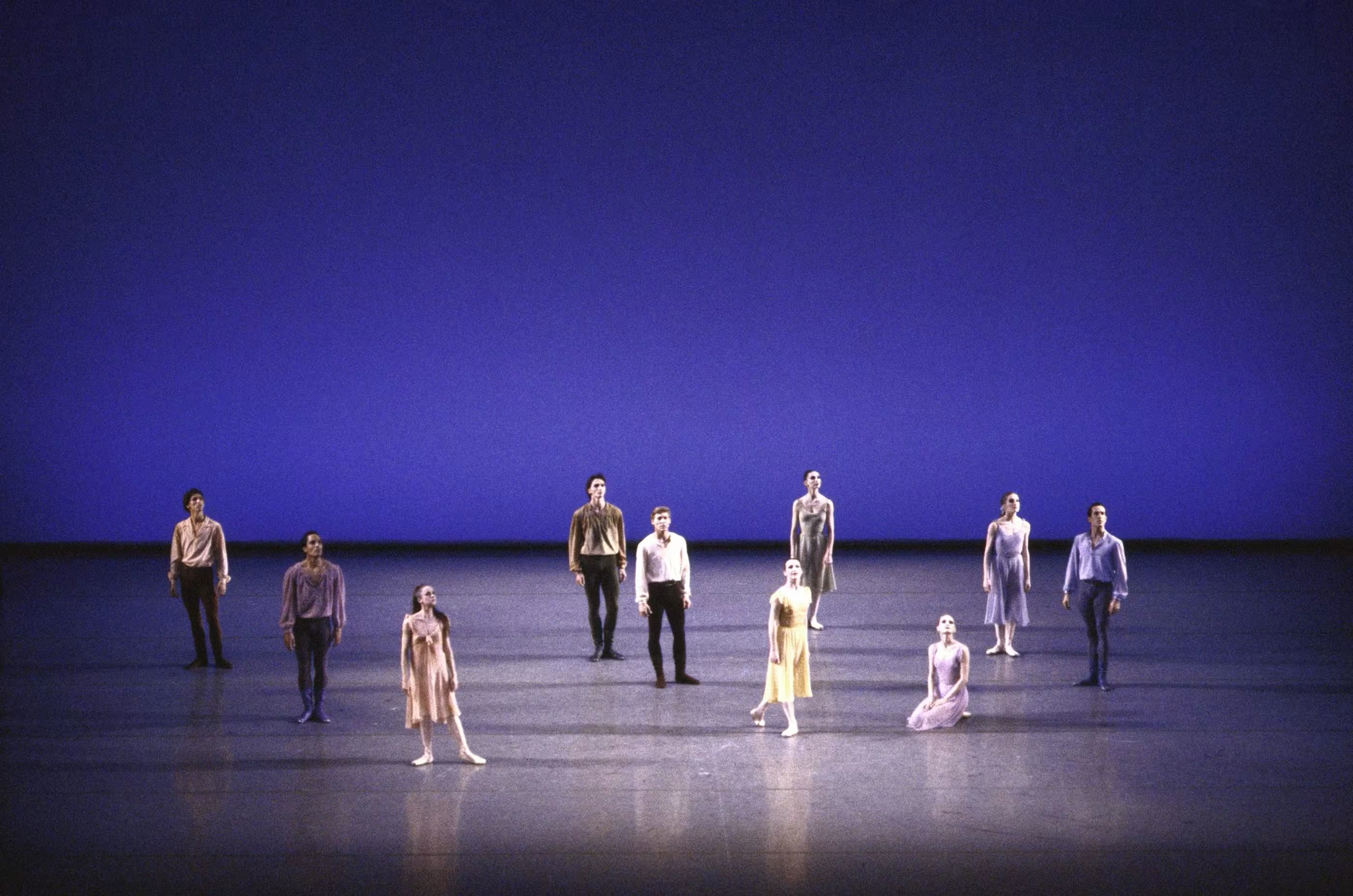


PhotoDances at a Gathering (NYCB, 1990) © Martha Swope. Courtesy of the Billy Rose Theatre Division, New York Public Library for the Performing Arts
One of the masterworks of twentieth-century ballet, this nearly hour-long suite of Chopin piano pieces unfolds as a tender, communal poem about people who share a time, a place, and a love of dancing. No narrative, no scenery — only ten dancers, a pianist on stage, and the exquisite specificity of Robbins' musicality.
Special Requirements
Piano on stage
Choreography: Jerome Robbins
Music: Frédéric Chopin
Costume Design: Joe Eula
Lighting Design: Jennifer Tipton
10 dancers:
5 women
5 men
“It is as honest as breathing, as graceful as lark-song, and in some very special way more a thing to be experienced than merely just another ballet to be seen. It is also one of the most significant evenings in the American theater since O’Neill….Ten people are dancing in a grove. The stage is bare, accented only by Thomas Skelton’s joyously effective lighting, which seems to illuminate the ballet with just the right and tactful quality of exultation….Robbins has listened intently to the Chopin and appears to be able to dissect its structure without disturbing its robustly plaintive spirit.”
“Partners change as quickly as the mood, but the impulse to move to the beautiful music is constant. And although the dancers begin to interest us as individuals through their expression of melancholy, playful, whimsical, or daring moods, glorious dancing is really the point.”
“What distinguishes the movement from the usual ballet technique is its softness, its gentle elasticity, its airborne delicacy. Body lines are never held stiff in an attitude, but flow from one to the other….It ends as simply as it began, with everyone wandering on stage to listen enrapt to the end of the music, then bowing to each other and leaving in couples. As the title implies, this has been a gathering place for dancing and the evening is over.”
“It is a work of joy, beauty and enormous skill that should dispel any notion that Mr. Robbins is still not possessed of great creative powers.”
“Robbins’ first new ballet since Les Noces, and his first for this company since 1956’s The Concert, it is set to Chopin, lasts an hour, employs ten dancers and just a piano for accompaniment. And it may very well be Robbins’ crowning achievement….With unfailing invention, like a freshet of all the skills Robbins has manifested over the years, he has contrived a masterpiece.”
“Once in a while you see a ballet that is so eloquent, so true to itself that the critical eye is confounded. There is no resisting it; just sit back and let it wash over you. Jerome Robbins’s Dances at a Gathering is such a work. It is so transparent that through this one dance’s complex simplicity you seem to understand what Dance is all about…. Dances at a Gathering is a very quiet ballet; everything about it, every possible meaning is whispered – as if it were happening in such clear air that sound carries a great distance.”
“Dances at a Gathering, is not only a beautiful ballet; it is my idea of what choreography is all about….All the tiresome symmetrical clichés of classical ballet are avoided; Mr. Robbins’ dancers are grouped on the stage much as a painter composes the elements on his canvas, except that here the groups are always in motion, always splitting off and recombining….The striking thing about Dances at a Gathering is the deft use of abstract space and movement. It is pure ballet, put together with enormous skill, and it was brilliantly danced and totally enchanting in its effect.”
“Every now and again the curtain rises on a new work, and, almost before it has started, the audience knows that something very special is going to happen. Jerome Robbins Dances at a Gathering is such a ballet….Robbins once left ballet for several years, came back and created Les Noces. He waited for four more and now gives us Dances at a Gathering. We would like to think that this marks the beginning of his serious return to ballet.”
“Dances at a Gathering is one of the greatest ballets I have seen in a lifetime as a balletomane. It is more than that–it is a major adornment of American musical theater….Mr. Robbins’ act of affirmation mixes his own genius, the company’s, the art of dance itself into a vision of sweet amorous congress of mankind.”
“I have never before seen New York City Ballet dancers care about each other and care about themselves onstage. Robbins has somehow released them from a sort of balletic immaculate conception and given them to us with the same blood coursing through their veins that courses through ours….Robbins gives the nod to his Polish composer with a foot stamp here and there; one hand to the back of the head, the other on the hip; a suggestion of folk dance….Always the movement breathes with the music, but it breathes freely, knowingly.”