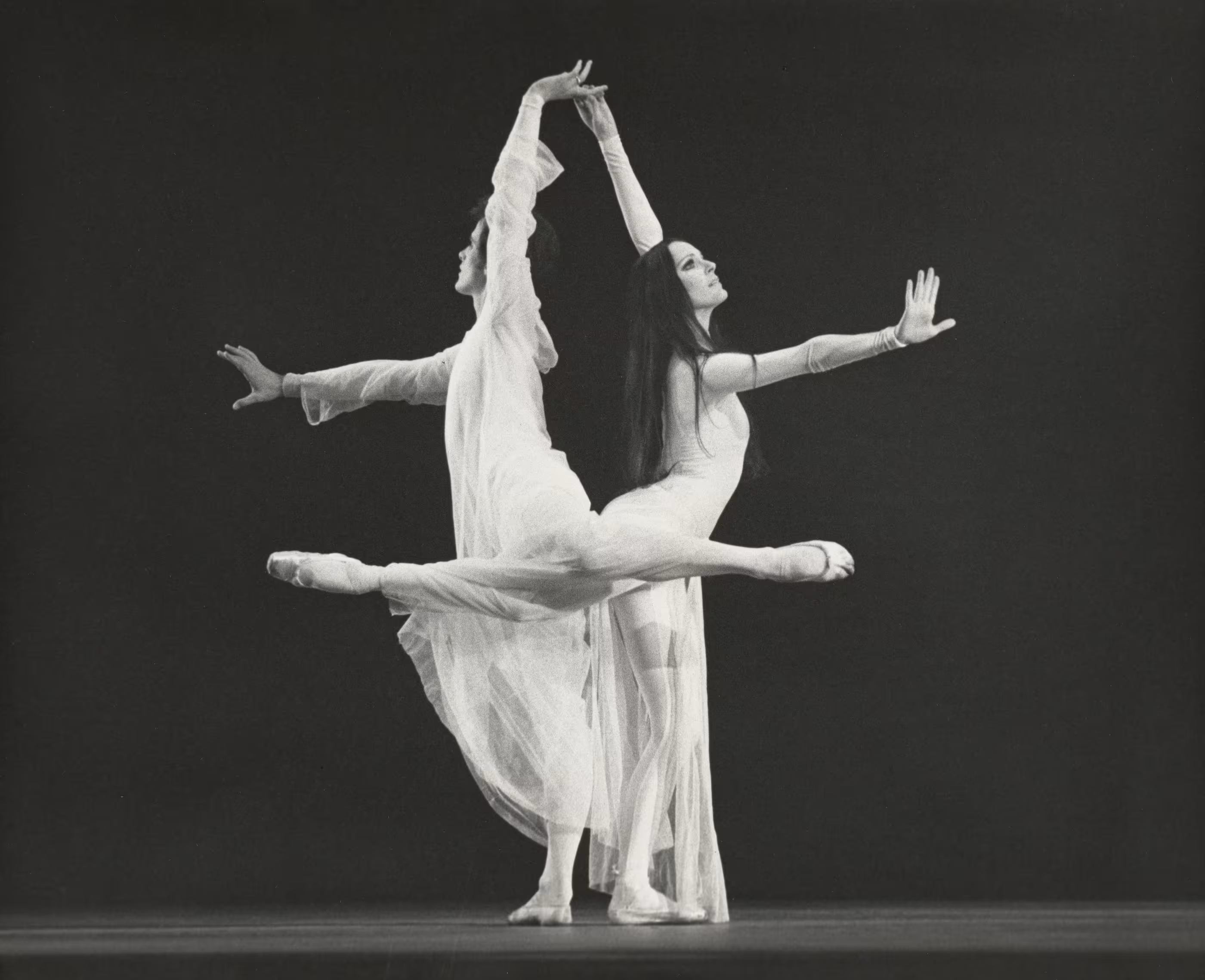

PhotoDybbuk (Tomasson, McBride, 1974) © Martha Swope. Courtesy of the Billy Rose Theatre Division, New York Public Library for the Performing Arts
Drawn from the classic Yiddish play by S. Ansky, this brooding and spiritually charged work explores possession, the power of prayer, and the mysticism of the Kabbalah. Bernstein's deeply personal score — steeped in Jewish liturgical music — meets Robbins' most dramatically intense choreography.
Choreography: Jerome Robbins
Music: Leonard Bernstein
Costume Design: Patricia Zipprodt
Lighting Design: Jennifer Tipton
Set Design: Rouben Ter-Arutunian
20 dancers:
Principals: 1 woman, 1 man
Demi-soloists: 4 women
Corps: 7 women, 7 men
“Where Mr. Robbins is especially skillful is in making visible the sudden surges of the music, and in always maintaining the texture of the ballet, which places desperate, at times demonic, love against the tightly cohesive pattern of society and its religion….At the heart of the ballet are the running duets for the hero and the heroine….For many years Mr. Robbins has been using the formal dance duet as a particular form of dramatic dialogue….There is a sheer theatricality in Mr. Robbins that at its best is Shakespearean and at its worst is showbiz.”
“Don’t expect anything like the violence or sensationalism of The Exorcist. Robbins’ viewpoint is more poetic, more gentle, almost wistful. He makes no strong statement–only the implication that the lovers would have been happy if paternal pride and religion had not interfered….Robbins makes no attempt to tell the story literally. But the numbers he creates are suggested by various phases of the drama….It is an oddly unexciting work for so emotional a subject, but it has lovely lyric moments and a haunting simplicity.”
“Robbins’ new ballet does not attempt to narrate the story of the play exactly, but it does follow the general theme of the work….One problem immediately arises. If you don’t know what a dybbuk is, or what the play was about, you won’t get much enlightenment from Robbins’ choreography….Robbins can’t seem to make up his mind as to whether he wants to reach for the truly occult or settle for mere stagecraft. The result is a ballet which deals in arcane symbols without giving those symbols illumination.”
“It comes across as a dancing cross between The Exorcist, minus the shock value and Romeo and Juliet Yiddish-style, minus Shakespeare’s words….It has Robbins’ dances that evoke memories of Fiddler on the Roof in slow, philosophical glide tempo to predominantly tonal music.”
“Jerome Robbins’s Dybbuk is so attractively staged and beautifully danced that it almost seduces one into thinking that it is a meaty ballet. Robbins has a fantastic gift for using every nook and cranny of the stage with ease and for instilling pictorial importance in the most simple formations….Robbins’s decision to treat the play as an abstract fantasy is legitimate, but what is so disappointing is the absence of abstract emotion, idea, or even point of view.”
“Dybbuk is a wan and murky evocation of the Hasidic legend that is all but drowned in a sea of pretentious metaphysical subfuse….Dybbuk is a sequence of abstract, related dance episodes that imply but do not explicitly contain a narrative structure….By far the finest segments of Dybbuk are the smoldering pas de deux for principal dancers Patricia McBride and Helgi Tomasson. Robbins has a flair for creating love duets that seem like extended caresses, and these are among his most lyric inventions.”
“Dybbuk is a blur of quasi-dramatic, semi-abstract, crypto-religious suggestions; its ambiguities are of the sort that test the patience rather than stimulate the imagination. Unable to gain depth of penetration, Robbins and Bernstein have settled for lateral sweep….The choreography, alternating between misspent brute force and feckless good taste, never develops a convincing dance equivalent for the play’s big scenes of primitive terror–when the soul of the lovelorn seminarian passes into the girl’s body and she speaks in his voice, and when the dybbuk is exorcised.”
“I can’t say what Jerome Robbins had in mind when he created Dybbuk for the New York City Ballet, and for once I think I’d like to know, because there’s something vexingly slippery about the work as a whole. It’s a suite of dances pervaded by a gloom of Jewish ritual and punctuated by traces of drama from S. Ansky’s famous Yiddish play….Since Robbins could easily have produced either a striking ballet or a dance drama, I assume he intended neither.”
“There is no expressionist violence–in fact, hardly any facial expression–and not much narrative, but the resulting ballet is a work blazing with imagination and genius….No, ‘blazing’ is the wrong word. The Robbins ballet smoulders darkly. It is so odd, so unexpected, so original and so quiet that there is a danger that many people will miss the point altogether: many have missed it….Dybbuk has the simplicity and condensation of genius. Robbins possesses an original mind, as does Martha Graham, and like her he has forged an individual language to express his ideas.”