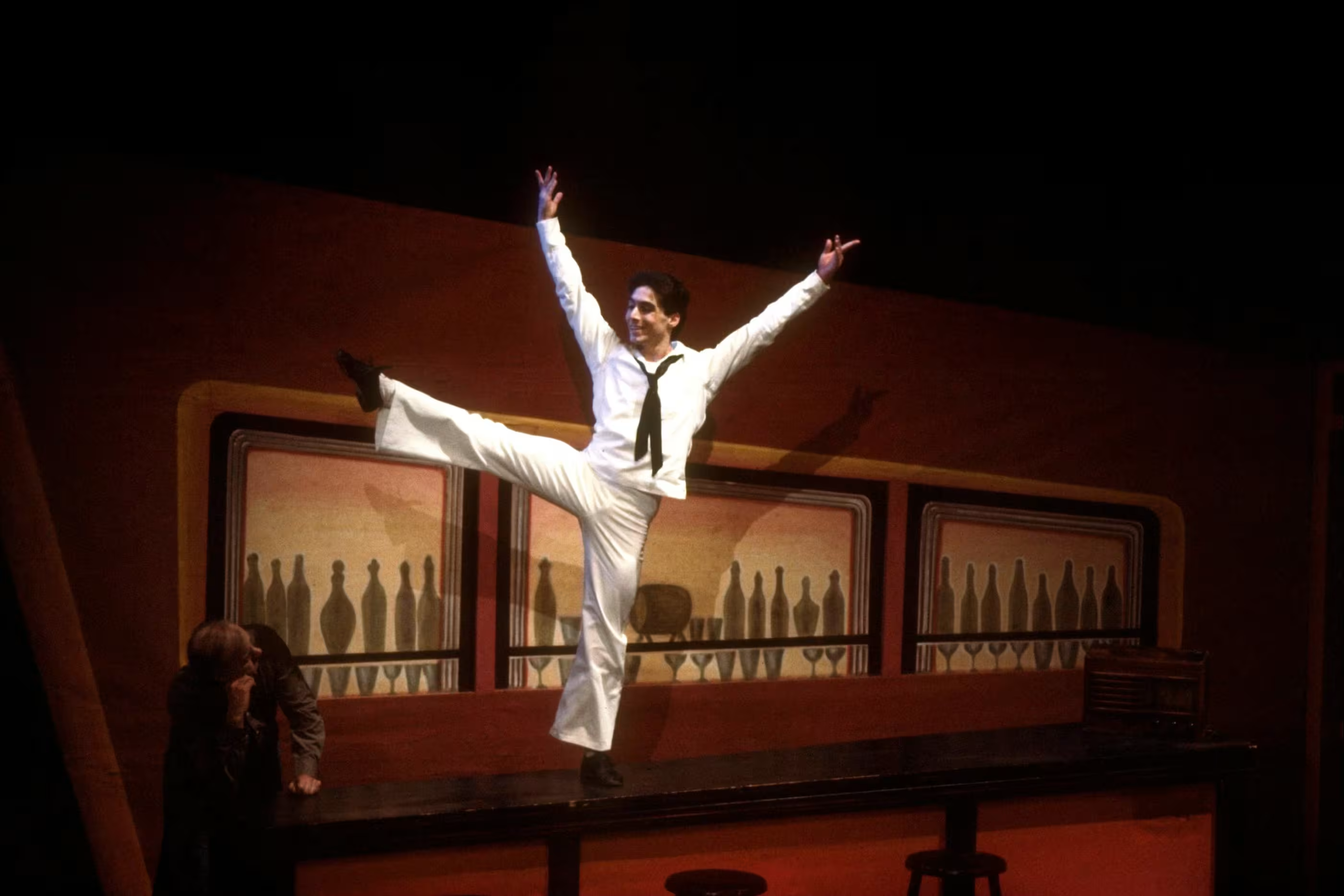


PhotoFancy Free (Frolich, 1986) © Martha Swope. Courtesy of the Billy Rose Theatre Division, New York Public Library for the Performing Arts
The work that launched two legendary careers — Robbins as choreographer, Bernstein as concert composer — in a single afternoon in 1944. Three sailors on shore leave compete for the attention of two women in an irresistibly American story of swagger, comedy, and heartbreak. It remains one of the most beloved ballets in the repertoire.
Choreography: Jerome Robbins
Music: Leonard Bernstein
Costume Design: Kermit Love
Lighting Design: Ronald Bates
Set Design: Oliver Smith
7 dancers:
3 men
3 women
1 bartender
“A ballet has finally been found for those who have passionately desired something to liven up the repertory….The whole production shouts like a billboard poster. There is a sophistication among all the participants to make it evident that they are aware of the blatancy. But little is done to balance it…. Mr. Robbins has an excellent sense of continuity and timing, and he has brought out the best qualities of his cast. But Mr. Robbins has still to master certain elements of taste and imagination.”
“Not since Agnes De Mille’s Rodeo has an audience taken so heartily to a ballet steeped in heartwarming homespun style. Equipped with some of the freshest gifts around town, the Ballet Theater staff has turned in a real hit, pointing the way to what may still show up as a strictly native chapter in ballet annals.”
“Jerome Robbins’s Fancy Free was so big a hit that the young participants all looked a little dazed as they took their bows. But besides being a smash hit, Fancy Free is a very remarkable comedy piece. Its sentiment of how people live in this country is completely intelligent and completely realistic. Its pantomime and its dances are witty, exuberant, and at every moment they feel natural….If you want to be technical you can find in the steps all sorts of references to our normal dance-hall steps, as they are done from Roseland to the Savoy.”
“It’s twenty-five minutes of strictly American ballet–and when it was over, the sittees and standees rocked the Temple of Art in raucous approval….Choreographer Robbins, Harold Lang and John Kriza dance the sailor roles expertly. Equally expert are the hussies, danced by Muriel Bentley, Janet Reed and Shirley Eckl. Non-dancing Rex Cooper is perfect as the bartender. He serves the drinks and keeps his mouth shut.”
“To come right to the point without any ifs, ands, and buts, Jerome Robbins’ Fancy Free is a smash hit. This is young Robbins’ first go at choreography, and the only thing he has to worry about in that direction is how in the world he is going to make his second one any better….The ballet concerns three sailors who pick up two girls and contest for the privilege of not having to be the odd man out. Each of them tries to out-dance the others, and–all of them succeed!….The whole ballet is just exactly ten degrees north of terrific.”
“Mr. Robbins has invested this little incident with such ingratiating toughness, such a distinctly American accent, and such infectious high spirits that the audience is constantly either snickering, applauding, or laughing outright.”
“Jot down Fancy Free on your list of ‘must-sees.’ It’s by all odds the best new ballet of the season. In fact it would be a stand-out in any season….Robbins is likely to have a flock of offers from Broadway’s major musical producers.”
“This was the début of Mr. Bernstein as a ballet composer and also the première of Mr. Robbins as a choreographer. Both young men made it plain they knew their business. Mr. Robbins’ staging was as expert as Mr. Bernstein’s writing. The responsibilities of a choreographer didn’t interfere with Mr. Robbins’ own able dancing as one of the three sailors, and it might also be noted that the most brilliant solo turn in the ballet was one he devised for Harold Lang, who stampeded the clientele with it.”
“The action unfolds with the compactness, the singleness of purpose, of a brilliant short story. Every step and gesture counts, and moreover, it instantly understood. And it calls for, and gets some, tremendous dancing.”