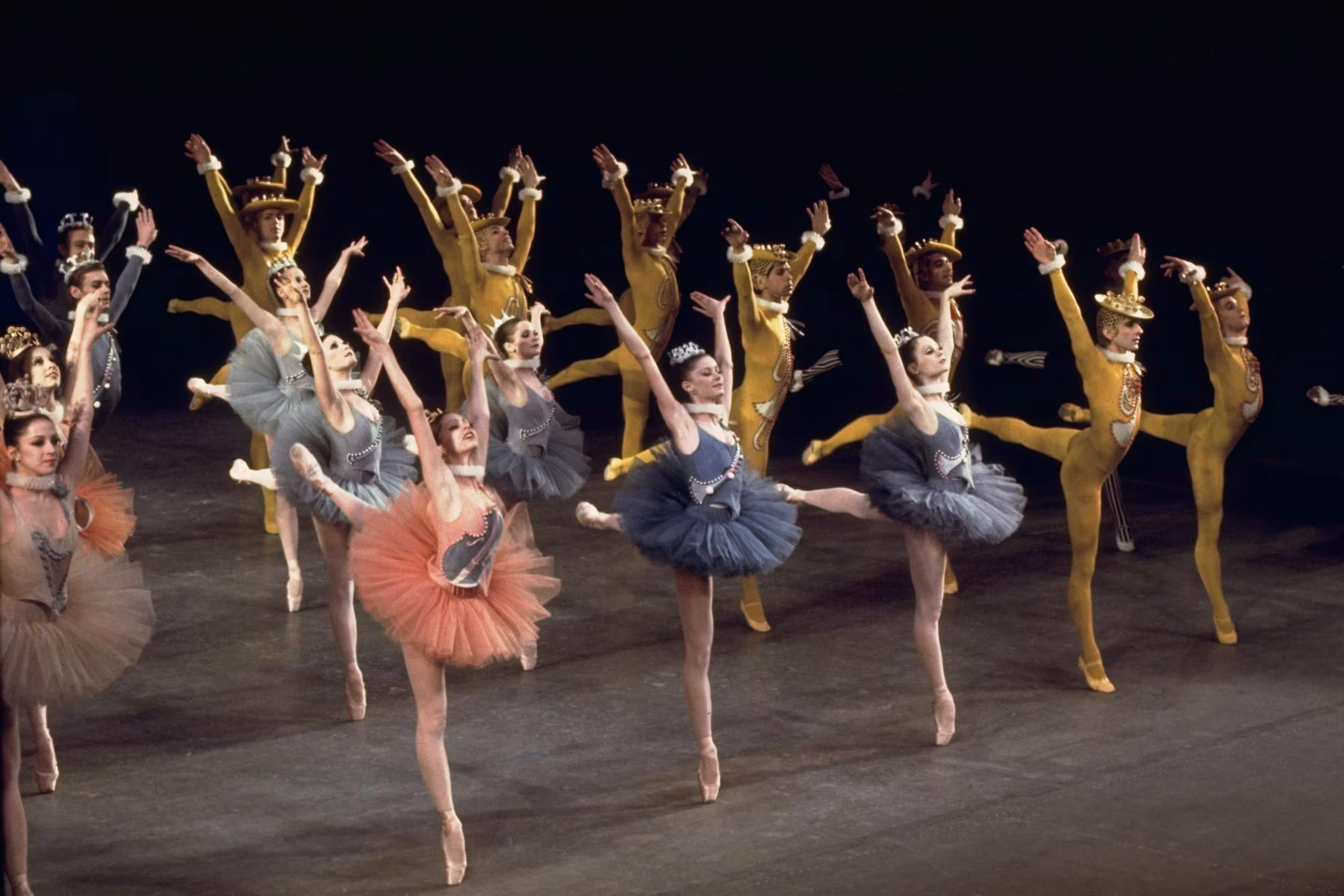

PhotoFanfare (NYCB, 1976) © Martha Swope. Courtesy of the Billy Rose Theatre Division, New York Public Library for the Performing Arts
Each section of the orchestra is personified by a dancer or group of dancers — woodwinds, brass, strings, and percussion — who perform as their instrument is introduced. Educational in conceit but theatrically alive, Fanfare is Robbins' joyful tribute to the symphony orchestra.
Choreography: Jerome Robbins
Music: Benjamin Britten
Costume Design: Irene Sharaff
Lighting Design: Jean Rosenthal
Set Design: Irene Sharaff
34 dancers:
16 women
18 men
Special Cast Requirements
1 narrator
“What might have seemed a mere tour de force, an amusing spoof, became the most delightful addition to ballet repertoire in a long time….What raises Fanfare to more considerable heights is the fact that Mr. Robbins has composed in lyric as well as comic mood. Some of the passages have great pictorial and poetic beauty.”
“Robbins has done with his dancers exactly what Britten does with his music. Based on a theme by Henry Purcell, the score is a series of variations by different sections of the orchestra with a final fugue by the entire orchestra….The woodwinds, then the strings, the brass and the percussion sections have their turns, as do the dancers who represent the instruments on stage….Robbins creates steps for his human orchestra which aptly suggest the musical sounds.”
“It is a simple, straight-forward work in the step-for-note tradition, smartly contrived and ingeniously sparked with touches of Robbinsian humor. As danced, played, and produced in its colorful costumes, it becomes a triumph of virtuosity.”
“Mr. Robbins has kept the intention exactly as it was, employing a ‘Major Domo’ to speak the explanatory lines at the side of the stage, and departing from the music only in the fugue….The whole thing, however, is perhaps too literal, even to having pictures of the various instruments on each costume. As choreographer he has simply followed along most of the time, breaking into characteristic comedy mood with the oboes, the tuba and trombones, and the percussion, but employing elsewhere a minimum of invention.”
“The Robbins work is an imaginative and original treatment of Benjamin Britten’s music for a British documentary film called Instruments of the Orchestra. It is roughly divided into two sections. First, a ‘Major Domo’ introduces various instruments and, as the representative dancers appear, they fit their dancing to sectional music….Once all instrumental combinations are introduced, the Major Domo advises the audience that they will now dance in concert. Britten’s basic themes are then assembled into a musical and choreographic composition.”
“Fanfare is courtly but its courtliness is suffused with good humor and peppered with mischief. Not only has Mr. Robbins selected and invented movements and, particularly rhythmic phrasings which appear to be visualized characteristics of the instruments portrayed and the themes allotted to them but he has also found the special brands of fun associated with, say, the tuba, the double bass, or the bassoons. One sees speed and lightness in the dancing of flutes, gliding legate in the celli, soaring in the clarinets, ripples and sweeps in the harp and fine pomposity in the percussion.”
“There is so much happy invention in the choreography and it is so good to see the bravely colored pennants hanging from the flies and the crisp, gay costumes of a stage full of dancers that, given judicious programming, Fanfare should be a most welcome occasion for a long time to come.”