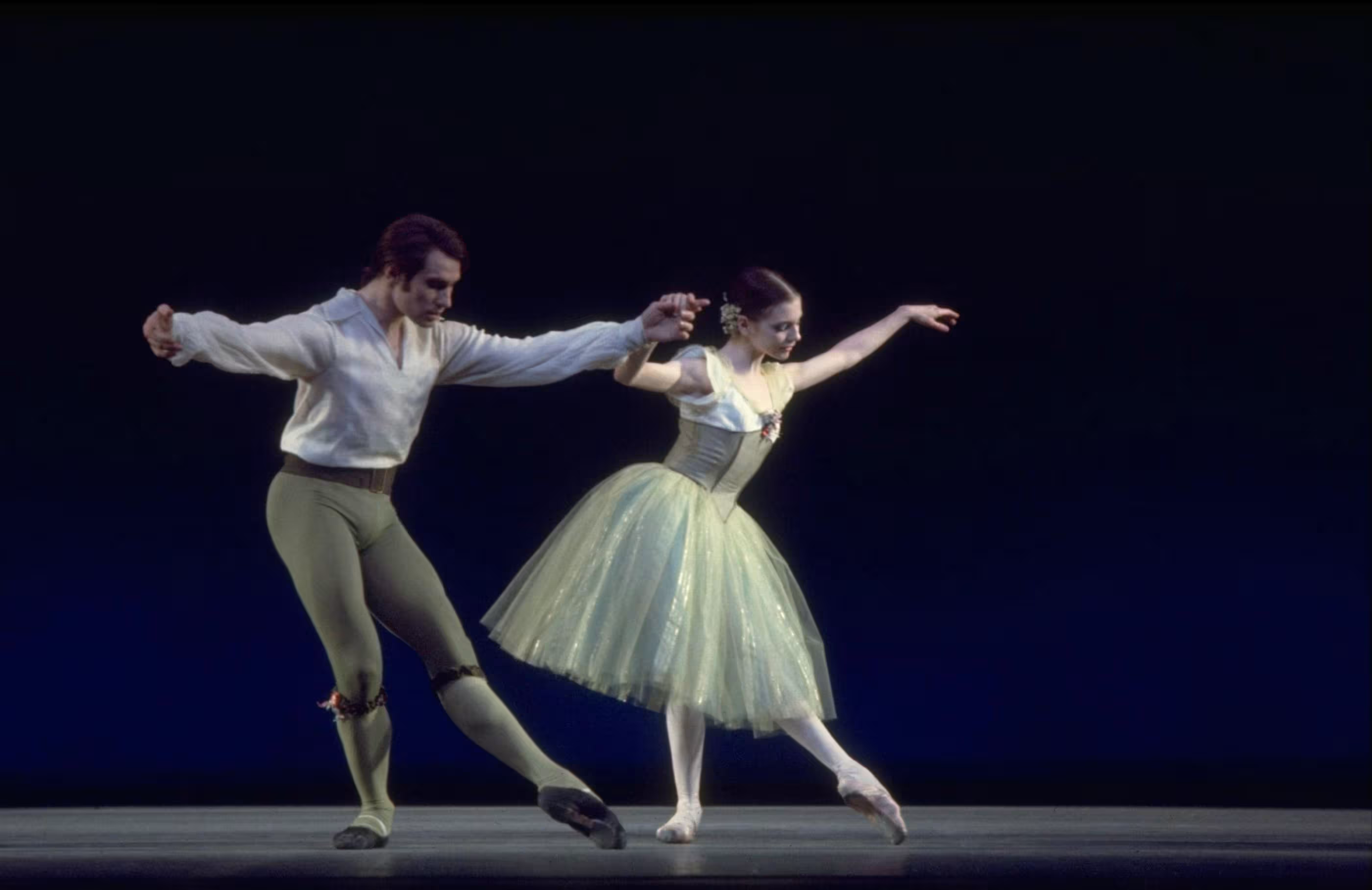


PhotoFour Bagatelles (Kirkland, Bonnefous, 1974) © Martha Swope. Courtesy of the Billy Rose Theatre Division, New York Public Library for the Performing Arts
Originally titled the Beethoven Pas de Deux, this elegant and musically astute duet sets four of Beethoven's miniature piano bagatelles with clarity and honors both the intimate scale of the music and the grandeur of the classical partnering tradition.
Special Requirements
Piano on apron
Choreography: Jerome Robbins
Music: Ludwig van Beethoven
Costume Design: Florence Klotz
Lighting Design: Ronald Bates
2 dancers:
1 woman
1 man
“As the title indicates, the work is set to four Beethoven bagatelles, played informally and enchantingly by Jerry Zimmerman. And although a trifle in size and scope, the dance has the same rich shimmering quality that Robbins caught so memorably in Dances at a Gathering….Just two people lifted by rhythm, both within and without, in a playful and peaceful and romantic mood. But for anyone who enjoys pure dance, it is more than enough.”
“It was pure dance, plotless except for the seemingly effortless flow of beautiful bodies moving to beautiful music as though they were a part of the sound.”
“Bagatelle means a ‘trifle’ in French, and this is a trifle of a ballet. It is also short and light, as are the piano pieces to which Beethoven is supposed to have applied the term Bagatelles….As they begin dancing, it becomes apparent that Mr. Robbins is paying a capsule tribute to the nineteenth-century classic ballets and their distinctive styles….Four Bagatelles is deliberately ‘naif.’ It is devoid of the kind of pretentious pieties that hung over, for instance, Mr. Robbins’s treatment of Stravinsky’s Requiem Canticles. Frequently, a minor work has a truth about it that a more ambitious piece cannot achieve.”
“It is, as its title suggests, only a bagatelle–but a charming one.”
“Jerome Robbins’ Four Bagatelles is so sleight-of-hand and beautifully danced by Gelsey Kirkland and Helgi Tomasson that one wants to pass it off as a lovely trifle. Maybe that’s what Robbins wants one to do. But no, it’s a trifle with a difference. It’s a classical pas de deux, set to Beethoven, no less, and as though for an opera house….Overriding the whole ballet is a tone of modesty, quiet and charm which spells trifle. Here’s the big rub: Robbins makes such a point of achieving a trifle that he achieves a Trifle.”
“Just as in Dances, one can relate to the boy and girl depicted here, for they live and breathe, they look into each other’s eyes like real people, not like dancers who have simply been given a pattern of steps to perform….Four Bagatelles abounds in contrasting movement, from the quiet beginning as the pair move gently hand in hand, to the soaring lifts that have become familiar in most of Robbins’s latest works; from the circling bourrees to the big, bounding jumps and beats that swing from side to side.”