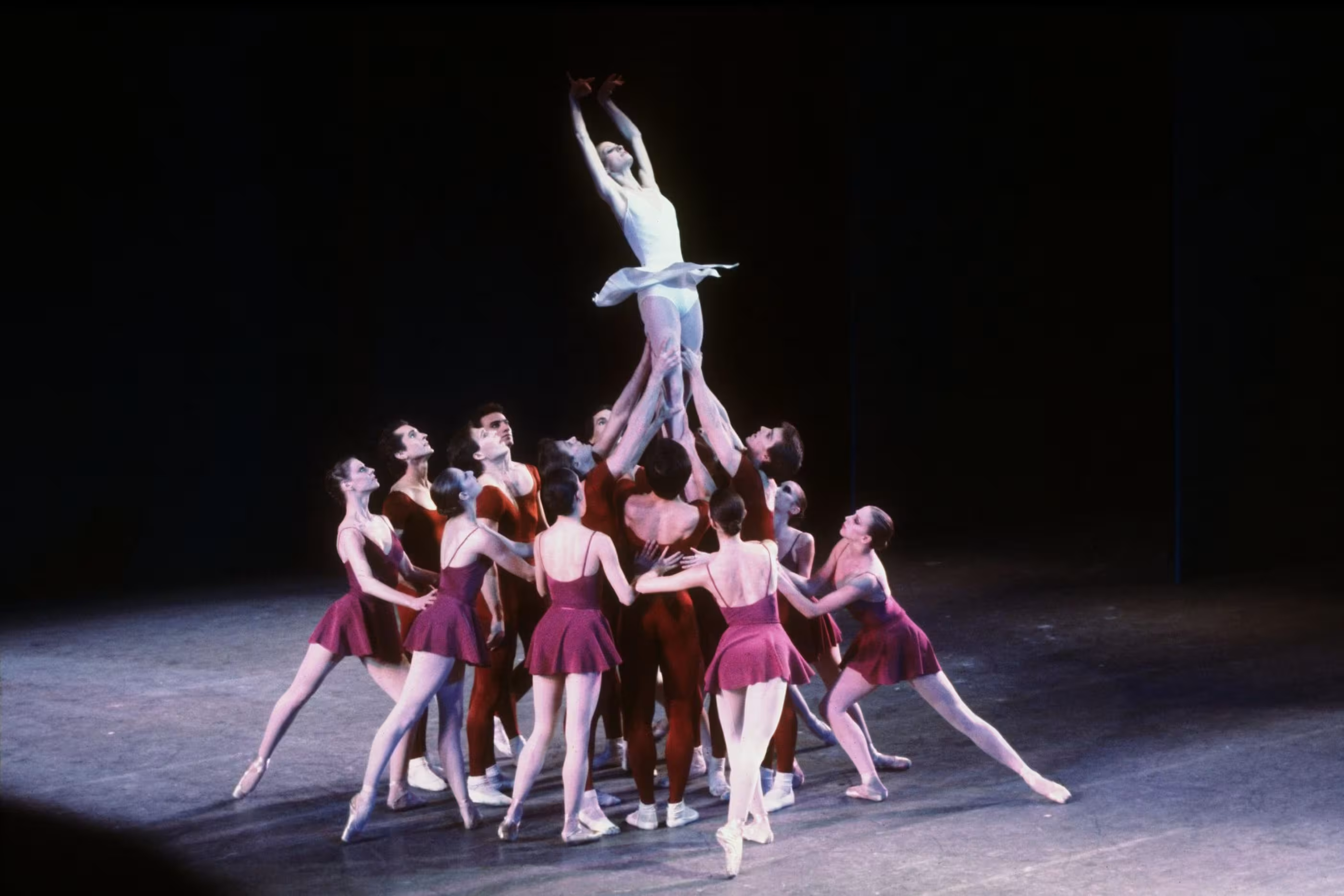


PhotoGershwin Concerto (Calegari, 1982) © Martha Swope. Courtesy of the Billy Rose Theatre Division, New York Public Library for the Performing Arts
A jubilant, large-scale celebration of Gershwin's most ambitious orchestral work, fusing the rhythmic vitality of jazz and Broadway with the formal structures of classical ballet. Big, brash, and exhilaratingly American, it was created for New York City Ballet as a love letter to the city and its music.
Choreography: Jerome Robbins
Music: George Gershwin
Costume Design: Santo Loquasto
Lighting Design: Thomas Skelton
Set Design: Santo Loquasto
28 dancers:
Principals: 2 women, 2 men
Corps: 12 women, 12 men
“It is Robbins at his most masterly….Robbins has captured two things….The first is the art of choreographic characterization–the absolute realization that dance is music set to people and also people set to music….His second area of mastery is in the matter of musical visualization. Robbins–even more than his guru Balanchine–wants to expose the structure of music and uses the structure as a clothes horse upon which to hang the draperies of life….Consider this new ballet–demonstrating Gershwin’s time and Robbins’s motion….The choreography cleverly uses counter-pointed movements to define the music, particularly the piano and orchestra.”
“Yes, one would call Jerome Robbins’s newest ballet, Gershwin Concerto, a masterpiece….This is a brilliant choreographer at his most complex, working on a startling level of formal ingenuity and also retaining his singular genius for capturing the essence of a national spirit….In Gershwin Concerto, Mr. Robbins captures the gaiety of the jazz age, also its underlying urbane loneliness….It would be easy to say that this is the show-biz Robbins again. Yet this would be wrong. For all its slinky, jazzy accessibility, the ballet is bound to become popular because it is art, not show-biz.”
“Robbins’s newest work, The Gershwin Concerto, seems to be a personal and affectionate look at Broadway and its environs in the 1930s, when Robbins himself was a young dancer….One might wish for greater clarity in the movement of the groups. Or that not quite so much weight had been placed on a score that wasn’t meant to bear the burden of a unified, serious ballet. But Robbins is once again following his theatrical nose–which is good news for American ballet.”
“Against an art deco backdrop with a huge ‘G,’ Robbins enshrines the soul of Gershwin’s piano in four crisply moving soloists, led by the technically dazzling, ebullient Darci Kistler. He impersonates the orchestra with a corps of 24 dancers and follows the episodes of the music as if he were charting a graph. Yet, where Gershwin’s music ultimately degenerates into appealing but theoretically unrelated vignettes. Robbins’ dance is unified with a tight vocabulary of motion and movements. It is a kind of visual cross-referencing that constantly reminds the audience that it is watching one work, not three or thirty.”
“The ballet, like its score, is often grandiose in scale and jazzy in actual content and the Jazz Age references are accentuated by the abstract Art Deco shapes in Santo Loquasto’s setting. To get an idea of what the work looks like, try to imagine a massive ‘symphonic ballet’ that keeps getting interrupted by the Charleston (and that is what does happen in The Gershwin Concerto)….The Gershwin Concerto can be seen as a summary of Robbins’s excursions into jazz-influenced choreography from Interplay to In G Major.”
““That Robbins enjoyed working with this jazz-tinctured score shows in the spontaneity and vigour of his choreography, and the ballet has proved immediately popular with the public….What he has achieved is a perfect collaboration of sound and movement….Although there is a surge and force to the ensemble dancing that is exhilarating to watch, it is in Robbins’s invention for the principals that the ballet really catches fire….Elsewhere, Robbins borrows from steps of popular dances of the ‘twenties, such as the Charleston. He even brings in the waltz. For all that, the choreography never becomes bogged down in nostalgia.”