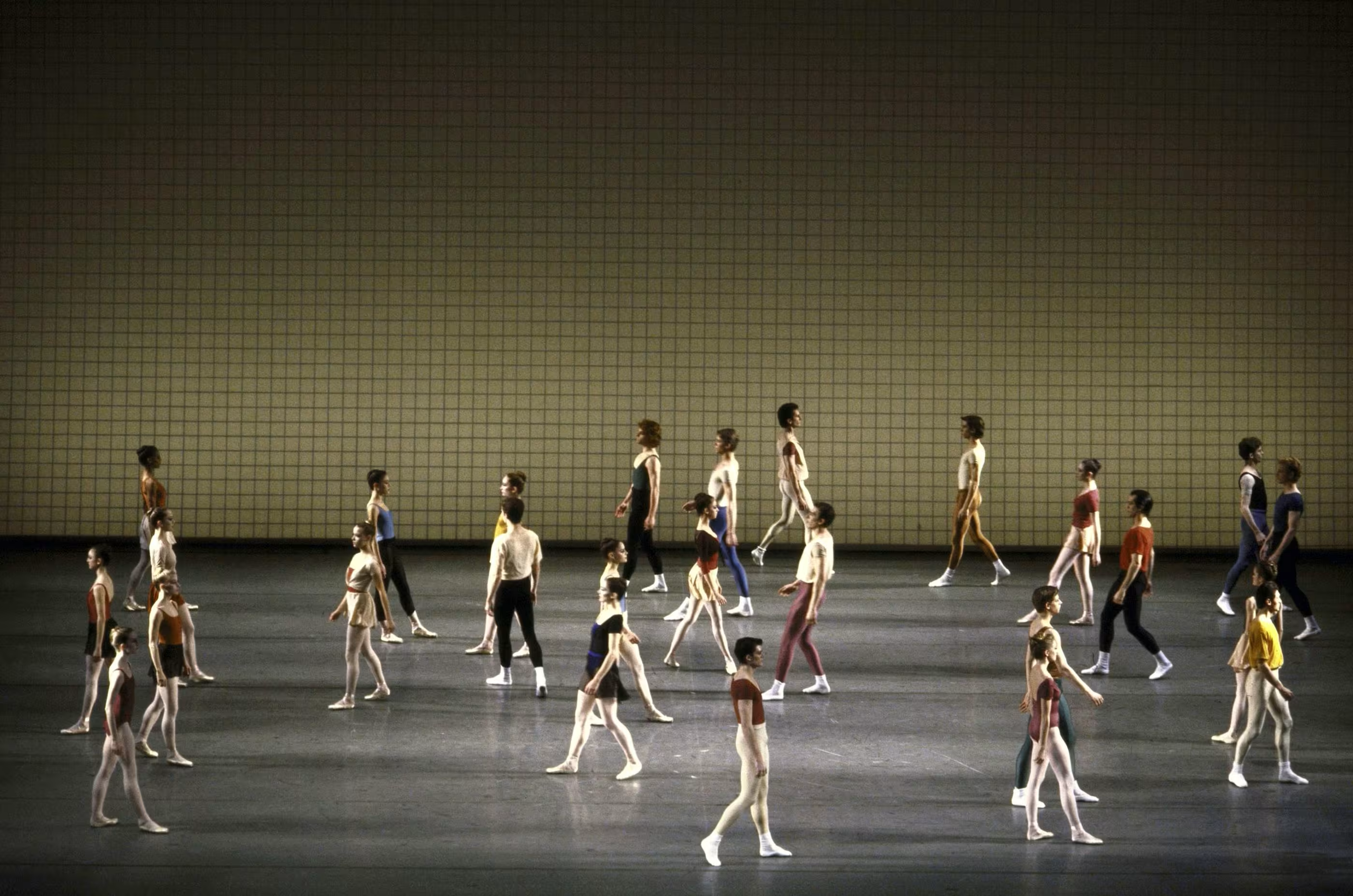


PhotoGlass Pieces (NYCB, 1988) © Martha Swope. Courtesy of the Billy Rose Theatre Division, New York Public Library for the Performing Arts
Set to Philip Glass's pulsing, hypnotic minimalist scores, this landmark work transforms the company into a kind of breathing organism — a metropolitan crowd in perpetual motion. The opening Rubric floods the stage with dozens of dancers in ceaseless patterns; the Facades pas de deux emerges from the throng as a moment of quiet grace.
Choreography: Jerome Robbins
Music: Philip Glass
Costume Design: Ben Benson
Lighting Design: Jennifer Tipton
Production Design: Jerome Robbins and Ronald Bates
42 dancers (no principal may double over sections):
I. Rubric
Principals: 3 women, 3 men
Corps: 16 women, 16 men
II. Facades
Principals: 1 woman, 1 man
Corps: 20 women
III. Akhnaten
Corps: 12 women, 12 men
“Robbins’ Glass Pieces is quite simply an asseveration of genius. Philip Glass’ music, a monotone to monotony, has its own impulsive interest. Robbins has caught this interest and made it into a design of simple power….The ballet uses a background of movement, sheer, almost unintegrated movement, as a counterpoint to its principals who weave through it with graceful oblivion….It has been one of Robbins’ virtues to keep up with the way we live. He is a poet of the instant. Nothing he has done shows this more clearly than Glass Pieces.”
““It is Robbins’ most daring and inventive work since the controversial Watermill (1972) and the richest and most rewarding dance he’s choreographed since The Goldberg Variations (1971), a piece that, curiously enough, the Glass dance resembles in a number of ways, from the large number of dancers involved to the kaleidoscopic colors and patterning that echo the richly interwoven textures of the score….Glass’ music always has a haunting simplicity, building with a spiraling subtlety that some audiences find ecstatic, others merely repetitive. Robbins seems to have understood the essence of this contradiction and has brought it powerfully to life.”
“Glass Pieces is stunning....Glass Pieces, for all its apparent strangeness, is thus again one of those landmark Robbins ballets in which the choreographer so shrewdly and penetratingly translates the temper of our times….It is a picture of our systematized times–the electronic age, the computer age. And it is always, through its very formal structure, a metaphor for the human striving to survive this systematization….It is important to stress Mr. Robbins’s insistence on classicism and toe work in Glass Pieces, because it is this very aspect that distinguishes it from other choreographers who have turned to Mr. Glass’s music.”
“Robbins has stitched into the structure of his work many of the things that characterize Philip Glass’s music….He has accomplished this with such deft theatricality that even the conservative members of NYCB’s audience are not likely to be shocked….Some of Robbins’s most stunning effects are accomplished not by the big, variegated ballet moves, but by simple changes in rhythm or direction, or tiny additions to a phrase. The frieze of women in ‘Facades,’ the squads slipping past each other in ‘Rubric’–ideas like these are the ones that impressed me.”
“The stage is hung with a plain beige sheet, lined like graph paper; most of the dancers wear practice dress and jazz shoes. It all has the look of some new, pristine adventure, yet what Jerome Robbins comes up with is a Jerome Robbins ballet. Exactly what the music ordered….Like the rhythm of rock, Glassian rhythm is static; as movement, it takes you everywhere and nowhere. Its sensibility is Eastern; its mode is ritualistic. To a Western romantic like Robbins, rhythm is abstract or anecdotal.”
“Formal, clear and well structured, it is his strongest work in years. It begins with 33 dancers, dressed in multicolored practice clothes, walking briskly across the stage, each alone, no two taking precisely the same route….The middle movement, to ‘Facades,’ is as serene as its predecessor is clamorous….The last segment, to a boisterous excerpt from Glass’s opera Akhnaten, is what his fans call ‘very Jerry’: arms up, fingers splayed, keep it moving….Audiences love Glass Pieces, and they are right….Take material like that and entrust it to a magic man like Robbins, and you will get something better than Broadway.”
“The music and also the graph paper set were thrilling, in part because they seemed to connote an entirely different, post-modern genre of dance. The use of a crowd (the corps numbered thirty-seven) and of very simple movements, especially walking, was another nod to post-modernism. But of course this was not a post-modern dance, because its core technique and vocabulary remained solidly balletic.”