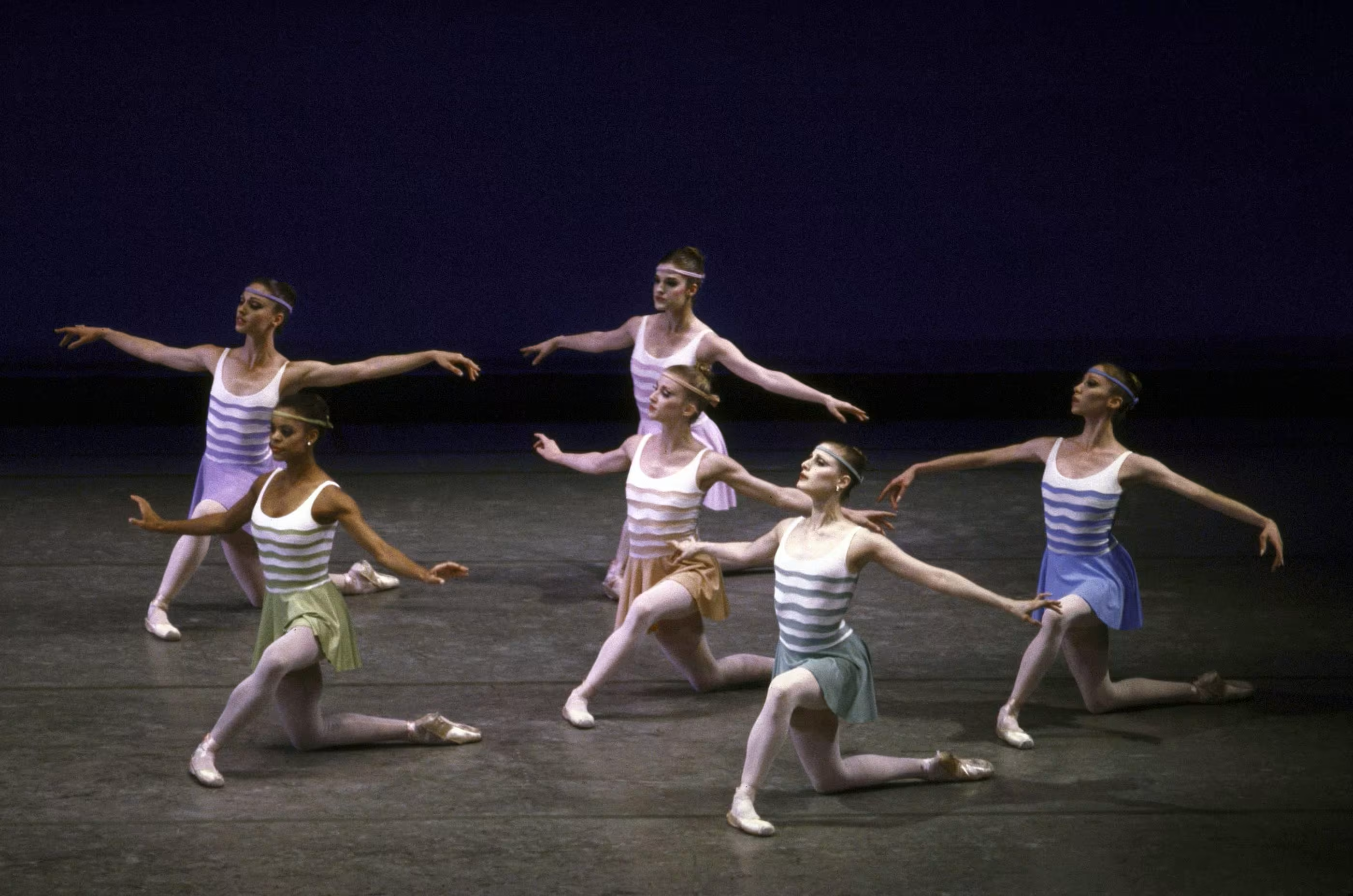


PhotoIn G Major (NYCB, 1987) © Martha Swope. Courtesy of the Billy Rose Theatre Division, New York Public Library for the Performing Arts
A sophisticated and glamorous work that captures the urbane shimmer of Ravel's jazz-inflected concerto through designs by Erté. Part Balanchine, part couture — fourteen dancers in six colors move with the elegant ease of a world between the wars.
Choreography: Jerome Robbins
Music: Maurice Ravel
Costume Design: Erté
Lighting Design: Jennifer Tipton
Set Design: Erté
14 dancers:
Principals: 1 woman, 1 man
Corps: 6 women, 6 men
“Where Mr. Robbins has been especially adept and adroit is in fitting the dances to the weight and mass of the music, and his sense of the music’s structure is particularly pleasing….At the heart of Concerto in G, for the slow movement, Mr. Robbins has devised a lovely, bluesy duet for Miss Farrell and Mr. Martins, casual and yet careful, making beautiful use of pauses, and showing just the same unfolding progression of movement that Mr. Robbins has always exhibited in the best of his pas de deux.”
“Here is another gem for the repertory in a class with his Dances at a Gathering….Part of its success, no doubt, is its dancers. They are Suzanne Farrell and Peter Martins, and you have to see them to believe how beautifully they perform….The slow, original lifts required of them are stupendously difficult, but they move through them with a fluid ease that’s like bodies floating in space….What a pair they make, and what a duet Robbins has concocted for them–quite unlike any other duet I can recall.”
“The long central section of the piece is a beautifully articulated pas de deux for Suzanne Farrell and Peter Martins. Robbins does not vary the emotional tone sufficiently–he clings to the music like moss to a cliff, rather than toying with it–but there are marvelous images in the duet. The work creates a fine contrast between brashness and fragility although it lacks the depth–in emotion and physical invention–of Robbins’ masterpieces.”
“Having written this concerto after visiting America, Ravel’s head was filled with jazz and Gershwin, whom he met. Robbins also picks up on jazz elements but, like Ravel, webs them into a classical framework….Whereas Balanchine has developed Suzanne Farrell’s sense of grandeur, Robbins has discovers her sense of pensiveness. One might debate which image is truest to Farrell’s body and being, but in truth, on Farrell anything looks good.”
“Robbins’ Concerto in G belongs to his Interplay and N.Y. Export: Opus Jazz moods. Acknowledging Ravel’s Gershwinesque writing, Robbins switches and melds ballet steps with jazz twists and slides.”
“Reviewing any work by Jerome Robbins these days is something of a risk. He fusses and tinkers with his choreography so much that two performances of a work are seldom the same….It is hoped that he will leave untouched Concerto’s second section, an extended adagio pas de deux for Suzanne Farrell and Peter Martins that ranks with Robbins’ loveliest creations. The best of his pas de deux have a sense on intertwined intimacy. They constitute a kind of visual poetry in suggesting, through gesture and motion, the moods and mystery of the relation between man and woman.”
“It was poetic and rousing, capturing the score’s subtle mood changes, the dreaminess and, especially, the jazz-like sections that Ravel openly stated were influenced by his fondness for George Gershwin and jazz.”
“Jerome Robbins’ Concerto in G is very good Robbins–clean, fresh, and high-spirited….Struck by its superficial resemblance to Interplay, I realize how far Robbins has moved away from literalness and punched home points. His tempering of long-lined, sharp ballet steps with small jazzy dissonances is very subtle, and the dancers don’t play boys and girls indulging in high jinks.”
“Concerto in G is a deceptively joyful exercise in aeronautics. At the start the dancers’ joy is compulsive, ritualistic. In the slow second movement, a beautiful pas de deux, Farrell and Martins break out of the ritual and pave the way for a jubilant Hollywood finale.”
“Concerto in G, a candidate for ‘major’ status by virtue of the score’s importance in the Ravel canon, is rather one of Robbins’ Sunday outings. Sunday outings can be important of course, but only by accident. Many of the sleight-of-hand devices in Concerto in G feel contrived–and there goes everything.”
“Robbins’ choreography for Concerto in G, as one might have expected, seized on its jazzy elements–the suggestions of the blues in the slow movement, the Gershwin-like syncopations of the outer ones.”