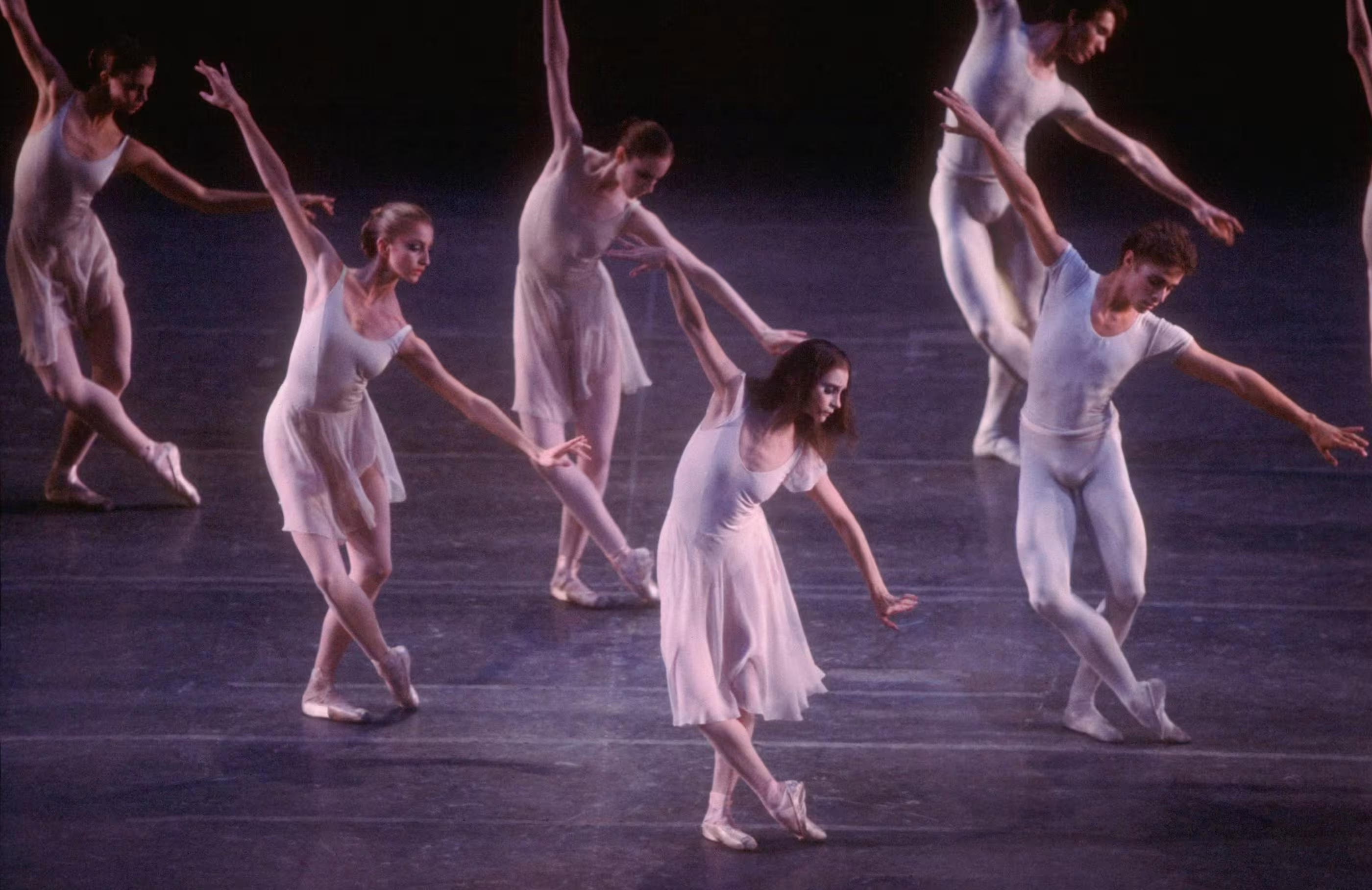


PhotoIn the Night (Ashley, Lavery, 1985) © Martha Swope. Courtesy of the Billy Rose Theatre Division, New York Public Library for the Performing Arts
A deeply moving elegy set to Berg's posthumously completed Violin Concerto — itself a memorial to Alma Mahler's daughter. Grave, tender, and luminous, the ballet moves through grief toward radiant acceptance with uncommon emotional authority.
Choreography: Jerome Robbins
Music: By Alban Berg
Costume Design: Dain Marcus
Lighting Design: Jennifer Tipton
Set Design: David Mitchell
19 dancers:
8 women
11 men
“Jerome Robbins has choreographed a moving ballet titled In Memory of… and it is about a young woman…who comes to terms with her own death….It has an admirable purity and refinement. Its drama is distilled through a prism of dance values rather than narrative terms….His achievement lies in the classicizing of his imagery, and Miss Farrell’s contribution is outstanding. Perhaps the poignancy of the ballet would not be the same without her. On the other hand, Mr. Robbins has brought out the drama and depth of her stage personality in a new way.”
“In Memory Of… is a highly dramatic work, more openly emotional than Robbins usually allows himself to be….Robbins goes boldly to Farrell’s melodramatic strain, and she responds by portraying the horror of death without any romantic gloss. He exploits her ability to defy equilibrium in shocking images of paralysis; she compliments him by never overplaying the drama….The ballet ends with a vision of heaven, indicated in the score by a beautiful chorale.”
“Certain passages of In Memory of… may be compared with other ballets by Robbins…The moments of unrest in the Berg ballet have a parallel in a scene of storm and stress near the end of Dances at a Gathering….Whereas the young people in Dances… gain the courage to endure and continue, the unrest in the Berg ballet presages the coming of death….The inevitability of death, the death of a great choreographer, and the cherishing of his ballets. In Memory of… may be about all of these things. Then again, it may not.”
“The level of meaning that Farrell brings to the ballet may have been intended to be nothing more than subliminal reinforcement of a theme; it turns out to be the theme itself….In Robbins’s choreography, which is the first he has ever created for her, Farrell both does and doesn’t look the way she looks in Balanchine’s ballets, and she’s more powerfully expressive when she does. Robbins hasn’t masked this power–he lets Farrell be Farrell.”
“In Memory Of… presents Farrell in the unfamiliar position of relying on her partner(s) to be advanced in space. The passiveness makes her look beautiful and very young, but also victimized….In Memory Of… uses the stage space shrewdly, and its portrait of a vulnerable Farrell provokes a decided fascination, but when you look at it several times, you realize that it doesn’t offer very much dancing in the way of linked phrases of steps: It proceeds by walks and lifts and isolated action on pointe.”
“Some have linked the work with Balanchine’s recent death and the title does imply that the loss of his great colleague may have motivated Robbins to create this piece….As the doomed girl, Suzanne Farrell caught all the choreographic nuances Robbins provided and her acting subtly conveyed the shifts of mood and drama. It was beautifully danced….Adam Lüders brilliantly captured both the cruel and healing aspects of Death in a fascinatingly faceted interpretation….The main applause must go to Robbins and his new muse, Suzanne Farrell.”