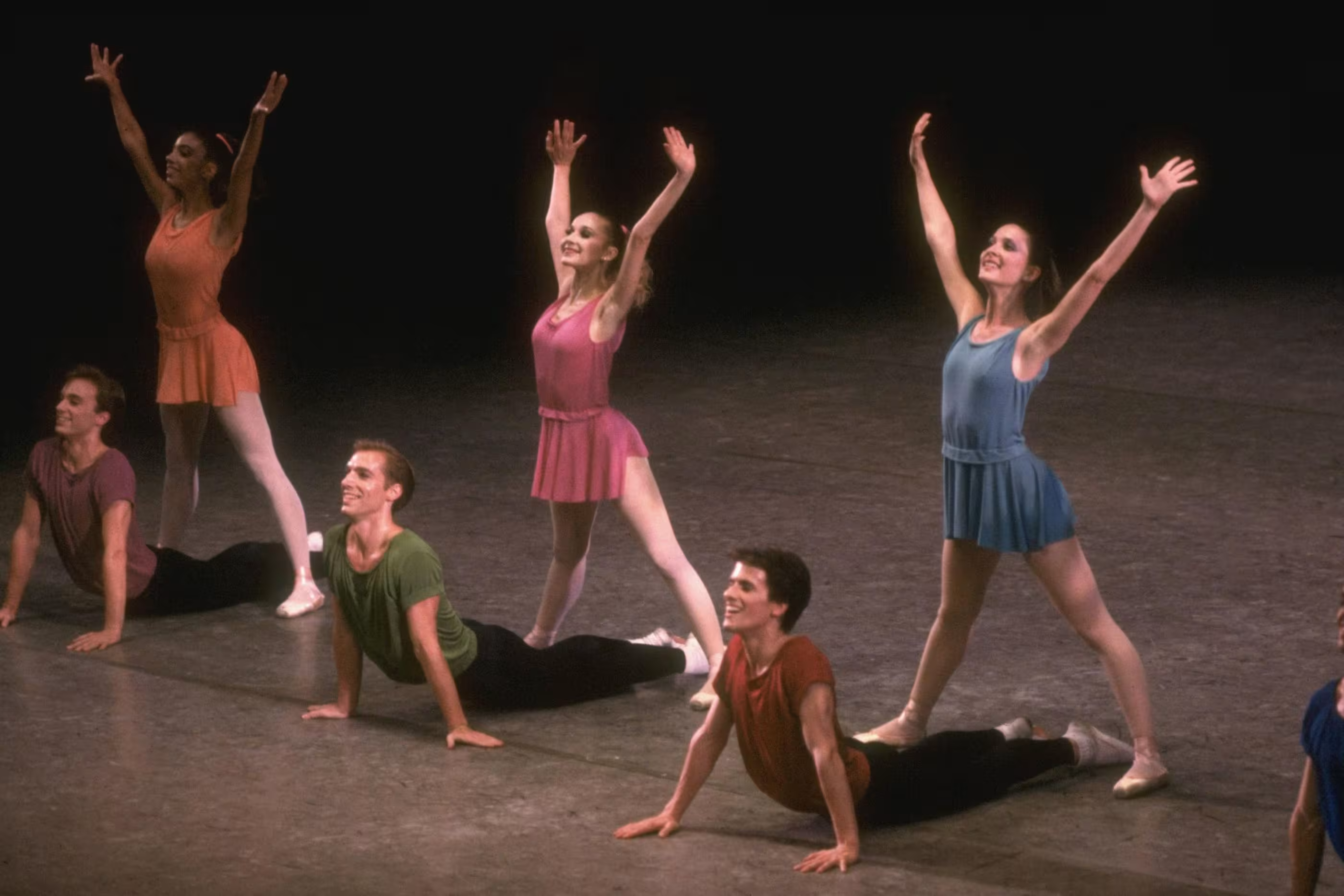


PhotoInterplay (Peter Boal, Cynthia Lochard, Kipling Houston, Roma Sosenko, Michael Byars, Alexia Hess, 1986) © Martha Swope. Courtesy of the Billy Rose Theatre Division, New York Public Library for the Performing Arts
An exuberant and irresistibly fun suite in four movements that fuses classical ballet vocabulary with American vernacular movement — jazz, athletics, and playground games. Robbins' second ballet, premiered in 1945, remains one of the quintessential American dance works: fleet, funny, and endlessly vital.
Choreography: Jerome Robbins
Music: Morton Gould
Costume Design: Santo Loquasto
Lighting Design: Ronald Bates
8 dancers:
4 women
4 men
“From all signs, this new frolic in snappy jazz-drenched idiom is here to stay. The crowd hugged it tightly to itself last night. It’s that kind of ballet–fresh, young, zippy, with a heartwarming mood radiating joie de vivre on a mass scale….Interplay’ is part comedy and part satire, all of it in good fun….In places you’ll recognize Robbins’ Fancy Free style–the linked trios almost tripping themselves up, the slightly sardonic sweeps of gallantry, the pepped-up classicism. You’ll also find jive and toe dancing mingled here in chatty ease. Jerome Robbins is the great leveler of ballet styles.”
“It is a quick, playful dance suite, smoothly combining classic steps with a few athletic and jazz moments. It is juvenile in atmosphere, expert in construction, sharp in rhythm. In dance continuity it is a big step beyond Fancy Free, though in emotion it is more innocuous. Its weakness as expression is in the superficial nature of the relationships between the dancers….But this is judging the little piece by really serious standards, and it is a proof of its merit that one feels like applying serious standards to a number that seems intended only as a friendly entertainment.”
“Those who expect to find in Mr. Robbins’ second ballet anything like a repetition of his first, Fancy Free, are doomed to disappointment. Interplay is a pure abstraction, without story or characterizations of any kind. Indeed, the most important aspect of the work is just this: for in it the choreographer has freed himself from the danger of being typed as a composer of genre, not only in the public mind but also, no doubt in his own….He has employed the basic approach of the classic ballet and its vocabulary to make a slightly jazzy, quite contemporary, American kind of dance.”
“In its revised version it is better than ever, and it was darned near tops in the first place. The set is naturally bigger and, to my taste, better, having undergone a process of simplification. As it is now, it is simple but not stark, colorful but not flashy….The ballet is a treat for the ear as well as a delight to the eye.”
“The Ballet Theatre went back to childhood games and athletics, last night, for an enormously effective and fast modern ballet called Interplay….Utilizing eight youngsters and a bare stage trimmed in spectacular orange, green, red and blue, this newest ballet item runs as fast and true as the good game which it is.”
“Jerome Robbins Interplay was like a breath of fresh air. It is what we have been waiting for from our young choreographers, a ballet which does not waste time with people standing around the stage and obvious quips that tarnish after you have seen it a few times….Anything said about Interplay must be qualified by he statement that it is a modest effort, about ten minutes long….But it is hard to believe it is so short, so packed with interesting dance movements. I wanted to see it right over again.”
“It is no small tribute to Mr. Robbins that Interplay gives the impression of just happening rather than of having been staged, and it is danced by eight cheerful, enormously skillful young people who seem to be just kidding around.”
“Interplay looks like a brief entertainment, a little athletic fun, now and then cute, but consistently clear, simple, and lively….The characters of Interplay seem to be urban middle-class young people having a good time, who know each other well and like being together but have no particular personal emotions about each other….The intellectual vigor, the clear focus of its overall craftsmanship suggest–as Fancy Free suggested in another way–that Robbins means to be and can be more than a surefire Broadway entertainer, that he can be a serious American ballet choreographer.”
“It is a demonstration on the part of Mr. Robbins that he can be ‘abstract’ with the best of them, when he wishes to. Of course there are touches of that comedic spirit which is a hallmark of Mr. Robbins’ best work. But the gist of Interplay is in its design as movement and as a pattern of rhythmic contrasts.”
“Interplay might have been subtitled ‘The Younger Generation,’ for it enlists ten of the company’s gifted youngsters in a breezy romp that hit last night’s audience squarely between the eyes….Mr. Robbins’ choreography, which tells only such a story as the observer may care to read into it, inherits the exuberance of Fancy Free with a few new wrinkles of its own. The music of Morton Gould invites Americanisms, and in the midst of classic ballet steps, slyly kidded, the dancers suddenly take to handsprings, cartwheels, and a game of leap frog.”