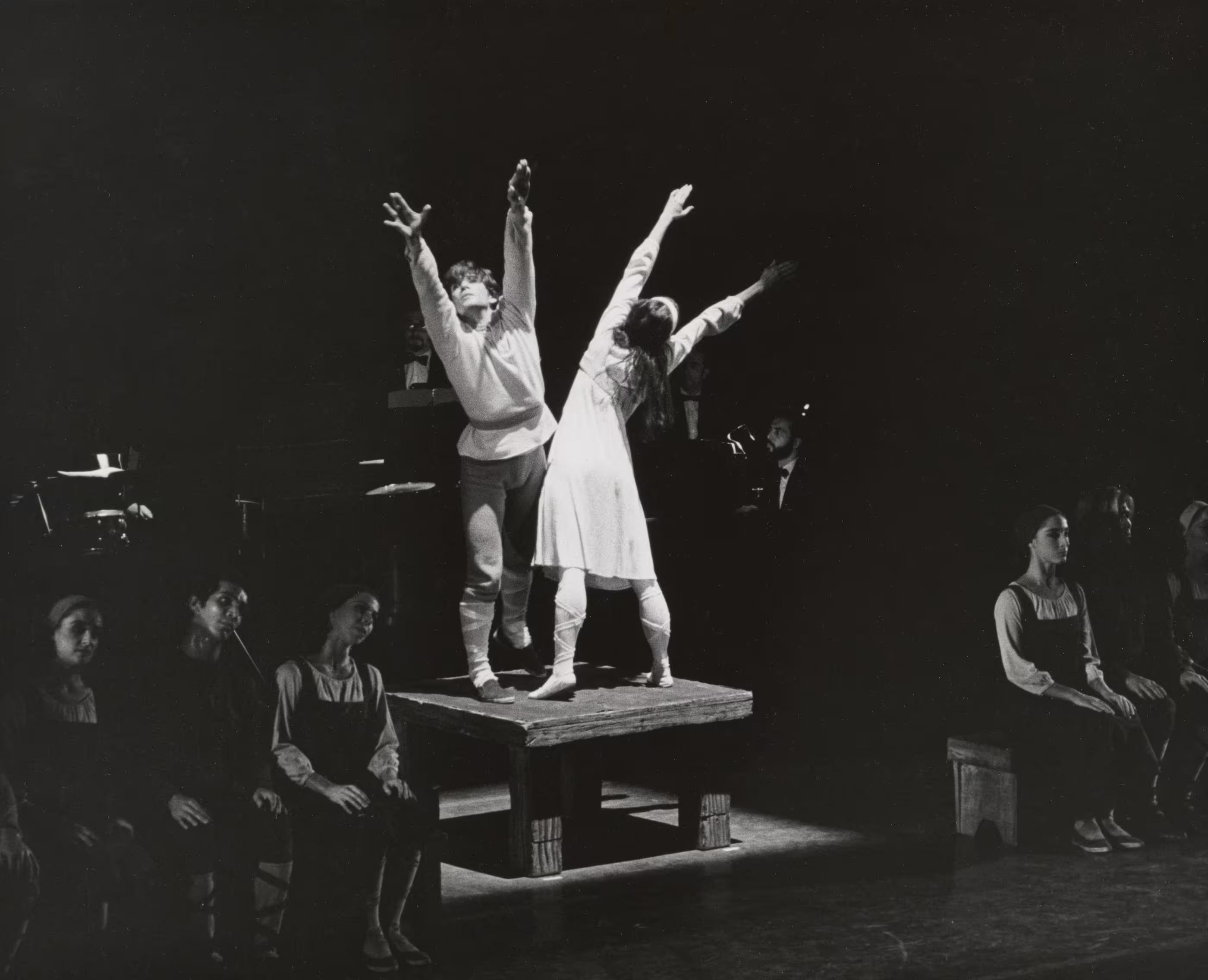


PhotoLes Noces (Martin, Glassman, 1965) © Martha Swope. Courtesy of the Billy Rose Theatre Division, New York Public Library for the Performing Arts
A stark, ritualistic, and profoundly moving depiction of a Russian peasant wedding, following Stravinsky's relentless cantata for four pianos, percussion, chorus, and soloists. Robbins strips the ceremony down to its essential force: the inexorable absorption of the individual into the communal will.
Special Requirements
4 singers
4 pianists
4 percussionists
Xylophone and timpani
Choreography: Jerome Robbins
Music: By Igor Stravinsky
Costume Design: Patricia Zipprodt
Lighting Design: Jennifer Tipton
Set Design: Oliver Smith
27 dancers:
13 women
14 men
“So, last evening, choreographer Robbins had two Russian weddings going for him–the warm, colorful ceremony in Fiddler on the Roof, with its spectacular bottle dance, and this wild affair at Lincoln Center. At the conclusion of the new one there was great cheering for everybody involved….It is an extraordinary visual interpretation of a difficult score.”
“Robbins has given a vigorous, almost athletic quality to the dancing which serves more as contrast than companion to the abstract modernity of Stravinsky’s music. But it is an effective contrast.”
“Jerome Robbins burst back into the dance world last night with a production of Igor Stravinsky’s Les Noces that is an almost overwhelming fusion of animal energy, ritualistic ardor and rhythmic attack….From the moment it begins until it ends, the work rushes at a headlong pace, something like a locomotive hurtling at top speed down a track that has no curves….Mr. Robbins has created in Les Noces an air of inevitability about the action that is as strong as that in The Cage.”
“While Robbins retained the severity of the work’s essential ideas, he vividly activated his powers of invention to dramatize the exuberance of youth, its healthy physical abandon, and its joy in the natural proclivity of the sexual body.”
“Les Noces calls for continuous rhythmic dancing from the beginning to the consummation, and Mr. Robbins has devised considerable geometric activity for them to enact. This ritualistic wedding celebration has both its athleticism and its bravura touches to stress the Russian accent….Mr. Robbins has stylized the dancing as a projection of Stravinsky’s ostinato rhythms. As the music is angular, so is the choreography.”
“Mr. Robbins did not select an easy route for his ballet comeback for he took as his challenge A Dance Cantata which the composer himself has said could probably not be really understood by anyone but a Russian….Mr. Robbins, of course, is not Russian. He is a New Yorker. But in his new choreography for Les Noces he has found movements and patterns and muscle dynamics which not only do honor to the powerful Stravinsky score but which also achieve a universal language, perhaps Russian in flavor but which echo the primitive, the folkloric past of any peoples.”
“A great many people were charmed by Mr. Robbins’ return to the ballet stage after a number of years spent choreographing for the Broadway theatre….The whole spectacle reminded me of a very artistic football game, in which the Bride and Groom alternately took the role of the ball, and this impression was heightened by the fact that the large chorus demanded by the score was seated at the rear of the stage on what certainly resembled bleachers.”
“In a lecture delivered in Memphis shortly after he had attended the premiere of Les Noces, George Balanchine twice stated that this particular Stravinsky score Cannot be choreographed. Be that as it may, Jerome Robbins made a thrilling ballet….Not many dance works are touched with the irony and wisdom of Jerome Robbins’ Les Noces. Not many grow from such a high degree of rhythmic fertility.”
“What is so special about Les Noces? Perhaps the fervor with which it has generally been greeted has a touch of relief about it….The company needed to create a masterpiece, a work that could unequivocally show that it was still a major creative company. The miracle came with Les Noces, and it came with such exquisite timing that anyone not having seen it with his own two eyes might be excused for being skeptical–but it is a most magnificent ballet. Indeed, much more, it is a summation of everything Robbins has so far been working towards.”