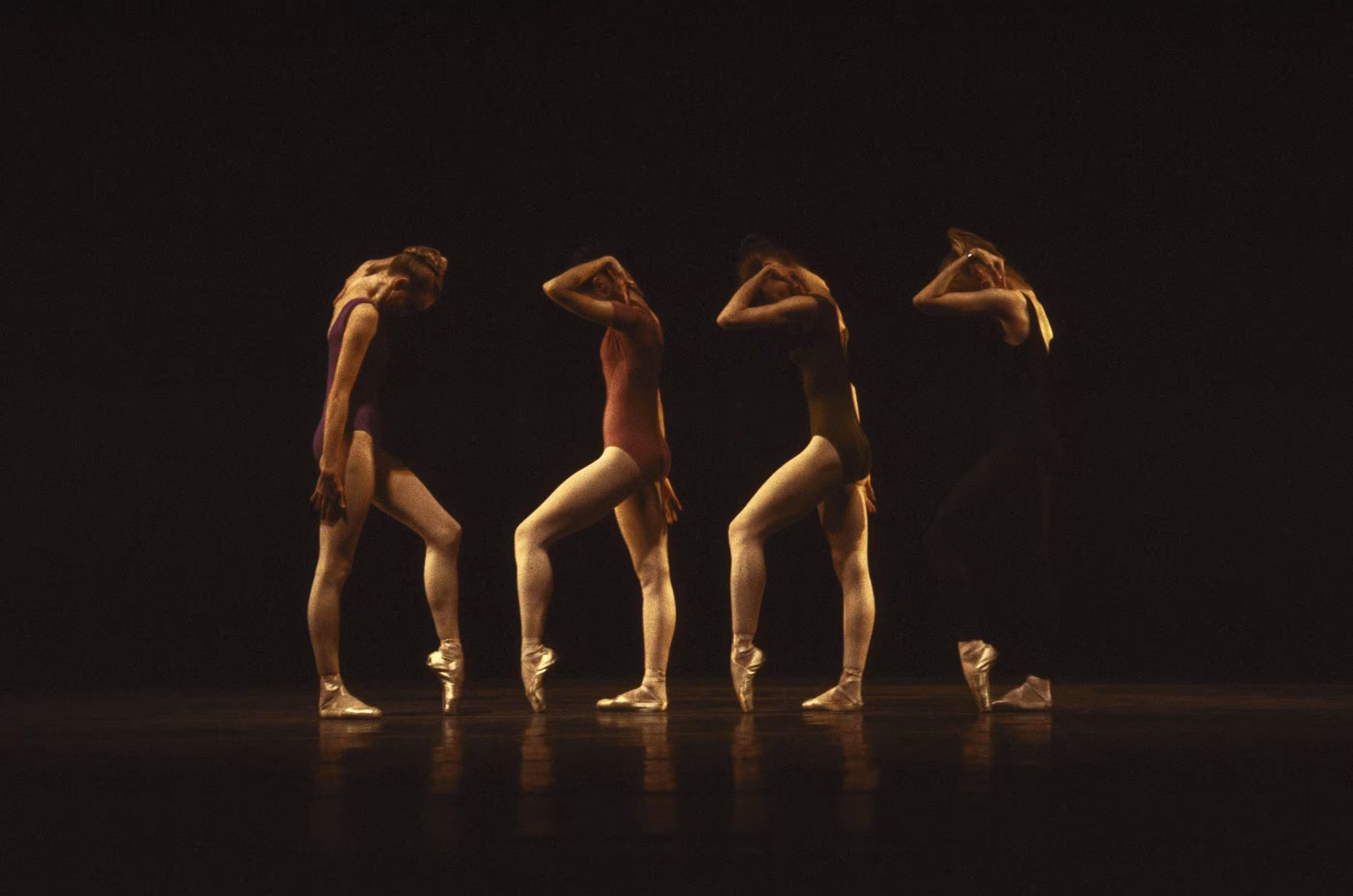

PhotoMoves (NYCB, 1984) © Martha Swope. Courtesy of the Billy Rose Theatre Division, New York Public Library for the Performing Arts
One of the most audacious works in the ballet canon, Moves is performed entirely in silence — no music, no scenery, no costumes beyond practice clothes. Only the sound of breath and footfall accompanies twelve dancers as they trace relationships, tensions, and spatial architectures with radical clarity.
Choreography: Jerome Robbins
Lighting Design: Jennifer Tipton
12 dancers:
6 women
6 men
“Jerome Robbins’ new ballet without music seems to have caused quite a sensation at its premiere in the Spoleto festival of Two Worlds earlier this month. Il Messagero of Rome pronounced it a ‘masterpiece by a great genius–a turning point in the dance. And it went on to call Mr. Robbins ‘the great maestro who can proudly claim to have taken from the hands of the great Russian teachers the scepter of choreographic supremacy of the contemporary world. Wow!”
“Moves is full of shifting moods and choreographic invention showing Robbins at his best. It is superbly danced by the company and it is evident that much work and iron discipline has gone into it for there is a rhythmic entity in spite of the lack of a given musical pattern….Both choreographer and dancers knew to perfection how to capture an audience without décor or costumes while maintaining perfect silence for nearly half an hour.”
“he absence of music and the odd mixture of movements, classical, modern and naturalistic, combine to bounce us out of the theatre into a fresh awareness far removed from our usual level mood of evening apathy.”
“The group of 14, dressed in studio leotards, move in silence with seeming spontaneity. Each member appears to wait for some inner impulse to drive him, whether in a mood of romance, play, fear, wonder. Yet the same impulse takes hold of the group so that they act together as an artistic whole, and not as a crowd of individuals. It is striking and varied and incredibly done–pure movement made into stimulating theater, which like so much of Robbins catches the lives of youth.”
“In Moves, the function of music has been taken over by the dance itself. Mood, rhythm, rhythmic variation, dynamic change–all of this is present, even though there is no sound in the theater. The eye sees what the ear expects to hear….The total effect is one of ballet newborn; of disciplined movement that is self-contained, engrossing and eloquent.”
“While this was a formal abstract ballet founded on cadence and dancers in motion, it was performed at breakneck speed. It’s effect on the audience was breath-taking.”
“It is a marvelous creation. Even without a musical base, it has rhythm, pacing, even silent melodies of action, for the rhythms here are born of instinct, impulse and imitation as the figures move in response to their own secret feelings, in echo to the actions of others, in compulsion to the electric touch of a hand or the meaning of a glance….But there are sounds in it, the sounds of dance, for breathing in various cadences of excitement can be heard and so also can the brush, stamp, tap of feet.”
“The opening event is Moves, which is by all measurement a tour de force, but a delightful and exciting one, never yielding to the temptation merely to startle, but at all times totally within the compass of dance….It is a daring and tremendous moment in modern ballet and every moment of is a perfection….Imitation of others, leadership of others, group work, all combine in a ballet that is excitingly new and fresh.”
“The work was done in silence, and it is phenomenal the way the dancers had been trained to absolute rhythmic awareness of each other….The structure of Moves made a full, neat circuit. The human relations–the identity of the sexes–remained as inconclusive as at the outset.”