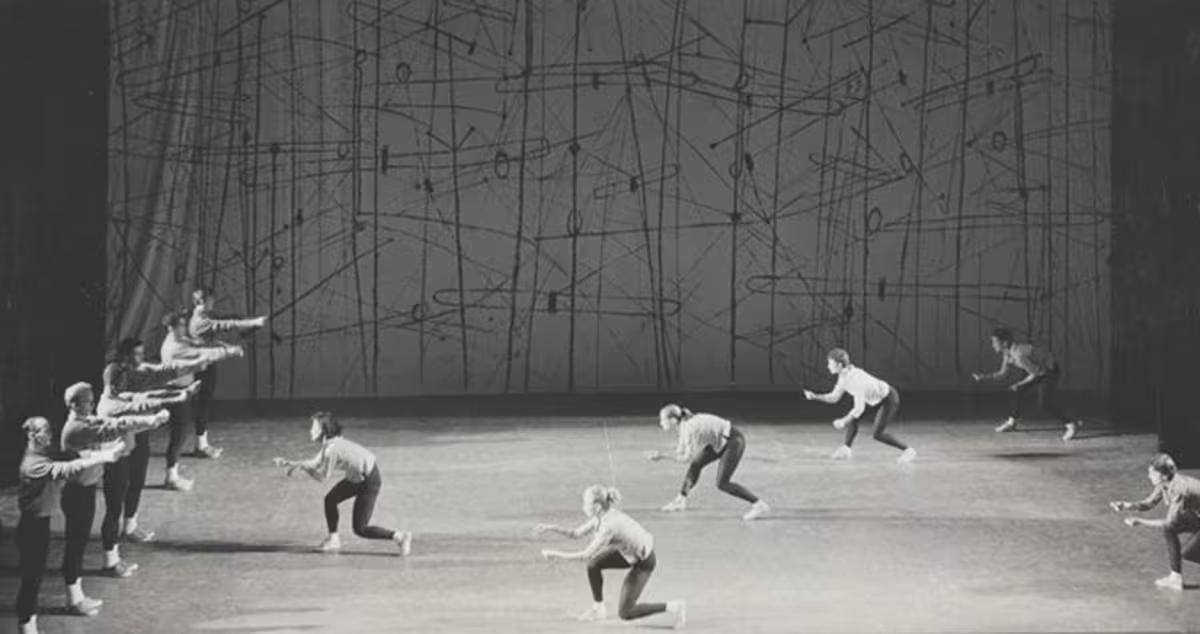


PhotoNY Export Opus Jazz (Ballets USA, 1958) © Martha Swope. Courtesy of the Billy Rose Theatre Division, New York Public Library for the Performing Arts
The defining work of Ballets: U.S.A., this cool, sharp, and intensely theatrical suite captures the street energy and competitive swagger of New York youth in the late 1950s. Jazz idiom and classical technique are seamlessly fused in five sections that feel as urgent today as when they were created.
Original Production
Choreography: Jerome Robbins
Music: Robert Prince
Costume Design: Florence Klotz
Lighting Design: Jennifer Tipton
Set Design: Ben Shahn
2026 Miami City Ballet Production
Choreography: Jerome Robbins
Music: Robert Prince
Costume Design: Zac Posen and Gap Studio
Lighting Design: Brandon Stirling Baker
18 dancers:
Principals: 2 women, 2 men
Corps: 7 women, 7 men
“The content of Mr. Robbins’ choreography is on two levels. Superficially he has used the vocabulary of the jazz age movement with delightfully amusing effect. But there is more to it; tension and conflicts that stir young people’s lives and color their emotions are caught with compassion….It is a successful distillation of the things West Side Story tried to say. It is allusive rather than literal and all the better for that.”
“Here were the pseudo-primitive posturings, the make believe voodoo pairings, the low rumbling rhythms spreading like a hypnotic trance.”
“A lithe and able young company perform these Robbins inventions very well, I guess and the inventions themselves look more or less like a choreographic collaboration between Mary Wigman and Walter Camp. Robbins says these dances–which are done in sneakers–represent the balletic tendencies of modern American youth.”
“It’s a mélange of rhythms such as you’re likely to find in dance halls, rehearsal studios and at jam sessions. It’s aimed at both the chi-chi and hepcat sets.”
“They might be the teenagers from West Side Story, the underprivileged city kids, and Robbins has caught their moods, their relationships and their lives as reflected in the music….It is a brilliant, haunting work, full of taut, offbeat movement that explores the jazz medium with new depth. And it is intelligently danced by a fine little group.”
“What it achieves is an extension of what Robbins created in Pied Piper. Its generic quality and its mood come through sharply. For some reason some of the movement appeared a bit dated just as though Robbins saw his youth in retrospect.”
“He has developed stunning phrases directly out of the music, and has given them an undertone of human reality through the relationships of his dancers….Both the rhythmics and the dynamics of the material are lively and full of simple but no less than inspired invention, and the five sections of the composition build steadily and inevitably into a genuine work of art….Jay Norman, Patricia Dunn, Wilma Curley, John Jones and Tom Abbott should be noted especially, but all of them dance as if they knew how good a work Mr. Robbins has made for them.”
“Here is a stunning theater work combining the discipline of ballet training with the jazzy movement idioms of today’s teenagers….N.Y. Export: Opus Jazz is a ritual of youth, not of delinquents but of the young whose boundless energies, occasional lostnesses and desperate desire for identity find outlet and form in these athletic, tense, partly humorous, surprise-laden actions of dance….The surface alone is magnificent theater but the ingenious patterns, the wonderful tricks, the urgent pace of the work, the moments of shy tenderness take on extra beauty if one realizes that here, wordless, is the voice of youth.”
“N.Y. Export: Opus Jazz is a tremendous feat of fast, expert choreography in the realms of today….Florence Klotz’ superbly right costumes mate with the scenic work of Ben Shahn, the Robert Prince score draws in all of the elements and the dancers do the rest. Don’t shrink away, since this is not the danced outcry of the evil, delinquent, or vicious, but is the outcry of today’s lost youth, some lost, some poised, some sad, some glad, some merely bewildered. Spry forms, hot rhythms, gusts of humor and a general air of total youth make this a fabulous item.”
“Sure, Jerome Robbins’s Opus Jazz belongs to what an Italian critic described–in the démodé slang common to us layabouts and camp-followers–as ‘il mondo hot,’ but it also belongs to ‘l’epoca atomica’ and is an epic of our time….Opus Jazz is about the young of today, and addresses those mistrustful creatures in their own language….While the kids present themselves defiantly to us, crying ‘This was us. We did it. Take us or leave us or drop dead.”
“Speaking directly to the ‘shook-up’ generation, Robbins turns the well-worn idiom of contemporary jazz-dancing into fresh impact and makes of it a conveyor for piercing shocks of recognition. He communicates very well indeed, the inability to communicate among an alienated young generation caught between a world they never made and the horrifying premonitions of utter rootlessness….The praiseworthy company of dancers fulfilled Mr. Robbins’ conception with devastating intensity.”
“N.Y. Export: Opus Jazz hits audiences all over the world with an explosive force not because it is a wonderfully exciting dance spectacle (which it is), and certainly not because we sober-sided squares…are able to ‘identify’ ourselves with American teenagers, but because the ballet conserves the spirit not just of a specific generation but of the whole age in which we live.”