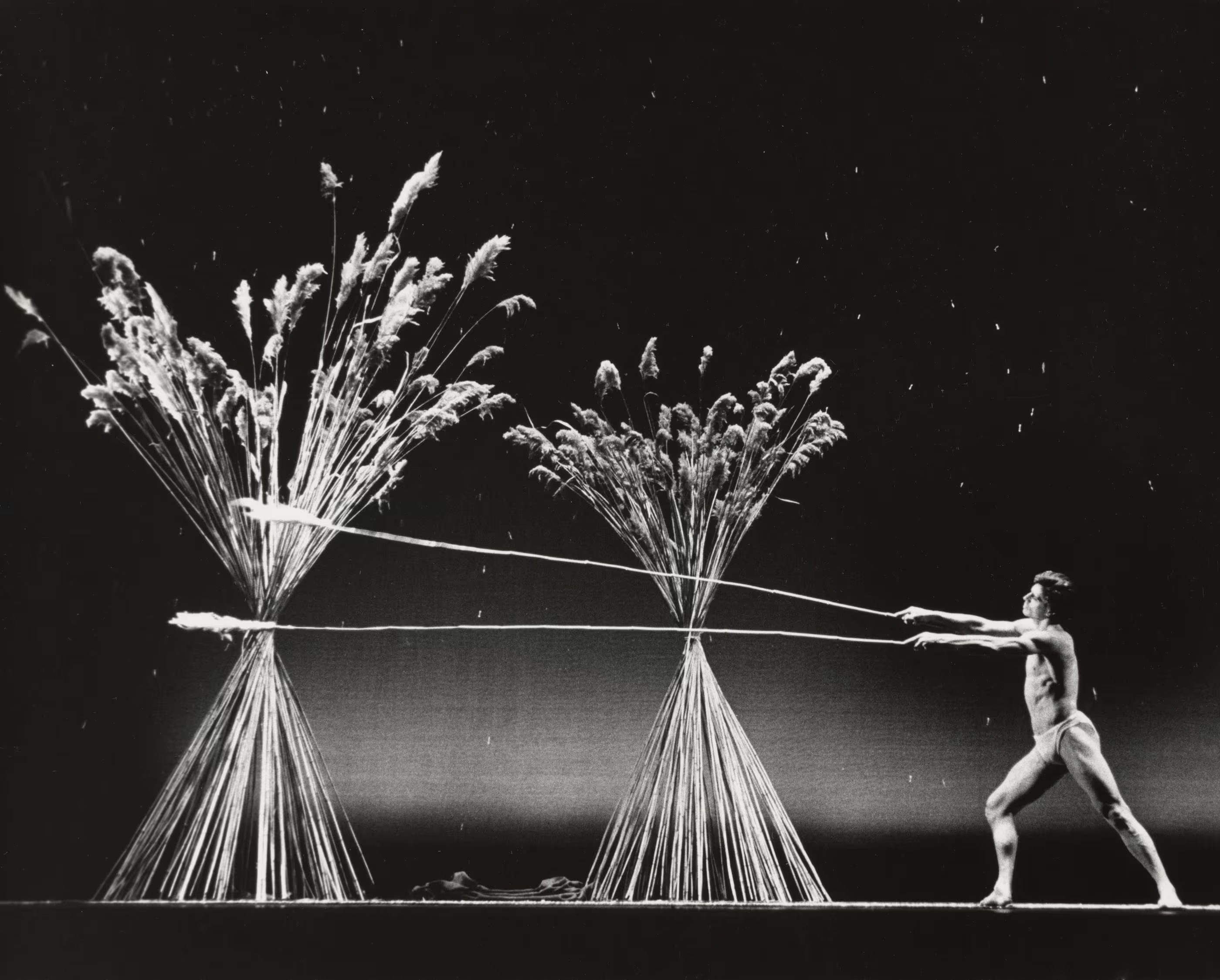

PhotoWatermill (Villella, 1972) © Martha Swope. Courtesy of the Billy Rose Theatre Division, New York Public Library for the Performing Arts
Robbins' most contemplative and controversial work, Watermill unfolds in near-silence and extreme slow motion, following a solitary man through the seasons of a lifetime in a Japanese-inflected landscape. Deeply meditative and unlike anything else in the ballet canon, it divides audiences even as it commands awe.
Choreography: Jerome Robbins
Music: Teiji Ito
Costume Design: Patricia Zipprodt
Lighting Design: Jennifer Tipton
Set Design: Jerome Robbins (in association with David Reppa)
24 dancers:
Principals: 1 man
Demi-soloists: 1 woman, 4 men
Corps: 7 women, 11 men
Special Cast Requirements
Ito’s ensemble: 6 Japanese instrumentalists (stage left apron, bleeding onto stage left)
“Very properly there were cheers, boos, and coughs for Jerome Robbins’s new ballet….And, in my opinion, the boos were from fools, the cheers were from heroes, and the coughs were from that strange and disinterested subscription audience that City Ballet wears round its elegant neck like an albatross….This is a fantastic ballet. It is a ballet that attempts to question the art of ballet and, indeed, our concept of the theater….The ballet concerns the life of a man….Edward Villella as the man–this strange acrobatic, slow-paced everyman at the hub–is superb.”
“It is less a dance than a beautiful, haunting experience, a sharing in a private world, a conception so new to the stage that it’s difficult to describe it to those who haven’t seen it….Everything happens as though in a dream, as though in the mind and memory of the central character….Whatever the intention, the work may not appeal to the usual ballet audiences. They may reject it as dance because the movement has so little apparent technique. But it is a total artwork, highly original, richly evocative, exquisitely lovely, and an experience you won’t forget.”
“This new ballet by one of the undeniably great choreographers of our time is also one of his most difficult to appreciate….In dance terms, very little actually happens. In terms of theme, everything happens. Watermill is a ballet that attempts to communicate the rhythm of life itself, to show that man is governed by the cycles of nature and yet can remain aloof from natural forces through his own will.”
“Jerome Robbins has set himself the enormously difficult task of creating a Zen Buddhist piece of theater that is palatable to Western audiences….This waking dream, accompanied by only the most incidental of music, is apt to prove agonizing to audiences used to greater activity in the dance. But it is awesomely lovely. Robbins has arranged his canvas like a series of paintings, each one exquisite in detail and the final effect of Watermill is haunting….Watermill will take time making its way into the repertory and, indeed, may never make it. Yet it is a towering achievement.”
“Like many masterpieces, it demands almost as much of its audience as of its creator….There is nothing quite like Watermill in the repertory, but then there is no choreographer quite like Jerome Robbins. He is growing and asking us to grow with him. I hoe we are worthy of the honor.”
“The pace is a little like that of Noh drama and also makes you think of Robert Wilson’s two dance-plays, The Life and Times of Sigmund Freud, and Deafman Glance….Watermill is very Japanese in style. The images are elusive, mysterious….A man (Edward Villella) stands contemplating the landscape….Perhaps he is the disillusioned hero looking for one thing that can contain, or explain, the essence of life; perhaps it is his own past that he is searching over. He seems to be at some crossroads….Watching Watermill is like watching an extraordinarily absorbing and beautiful scroll slowly unreeling past you.”
“Watermill is, I think, a powerful, disturbing work whose uniqueness is probably going to constitute its only possible detriment. It obviously cannot be entrusted to City Ballet audiences, unless they’re willing to undergo an I.Q. test as condition for buying tickets (not a bad idea in any case).”
“Where Dances and Goldberg Variations extended the range of dance, Watermill uses simple, generally unremarkable movements to extend the concept of theater….By distilling, simplifying and slowing down certain key experiences in a life, Robbins has achieved a brilliant kind of compression. The weight of a whole lifetime is conveyed in a mere hour of theater….The music, which uses a variety of Oriental and African instruments including the koto and shakuhachi in addition to the occasional far-off sounds of dogs barking and bird song, was a perfect, harmonious aural accompaniment to Robbins’ theme.”
“Very good indeed is the new Jerome Robbins ballet, Watermill, with dancer Edward Villella as an everyman reliving the ages of his life to music composed by Teiji Ito….It all has a slow, dreamy quality and achieves a special status not only as dance but as theater.”
“The dancers do move, but slowly….As a result, not only is there a kinetic intensification but an intensification of time itself. This is heightened by Teiji Ito’s reedy, sparse score, which falls like droplets into a pool of water. The central figure (Edward Villella) is the stillest of all….One begins to feel time, feel the muscles that enable a person to stand….Likewise, one must meditate on the moon that is going through its phases and ascending and descending, and on the wheat that moves ever so slightly. Nothing is happening. On the other hand, everything is happening…or is it?”
“Every so often–but not that often–a ballet turns up which instantly convinces one of its place in dance history. Such a one is Jerome Robbins’ Watermill, a creation of such imagination, depth and profundity that no one seeing it can remain untouched in some way by it….Watermill is a work of extraordinary beauty: a poetic and deeply felt work that seems to have been torn from the very soul of its creator….How incredible this choreographer is, never sitting back on the laurels of past successes, never choosing the easy way, but constantly challenged by new vistas.”